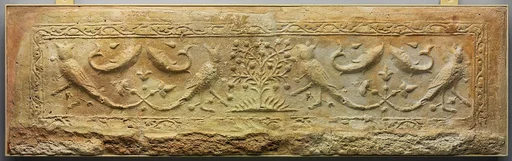
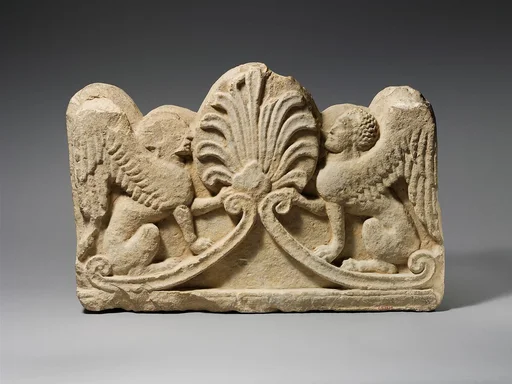
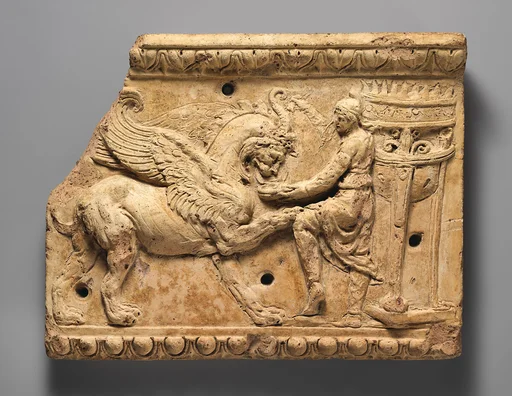
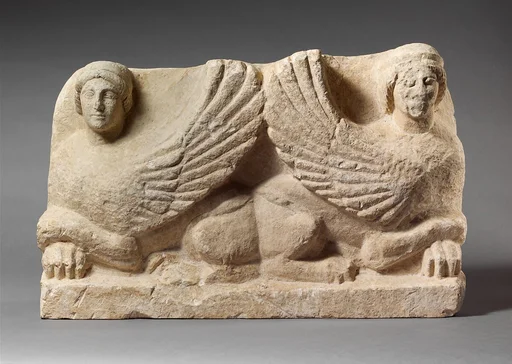
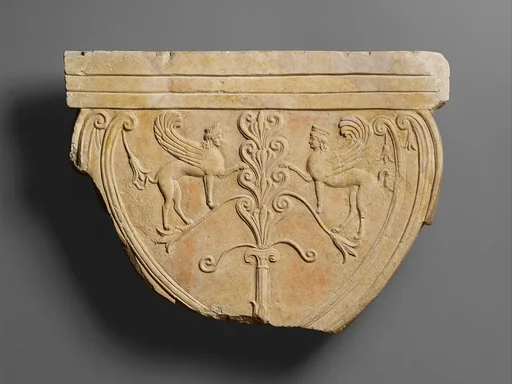
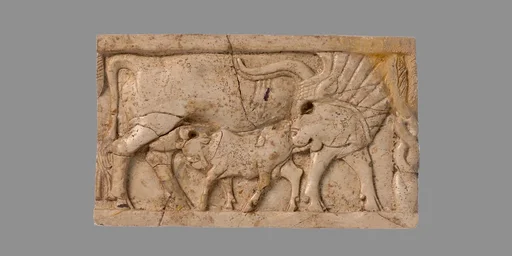
Door lintel with lion-griffins and vase with lotus leaf
Unknown
ca. 2nd–early 3rd century CE · Limestone · Ancient Near Eastern Art
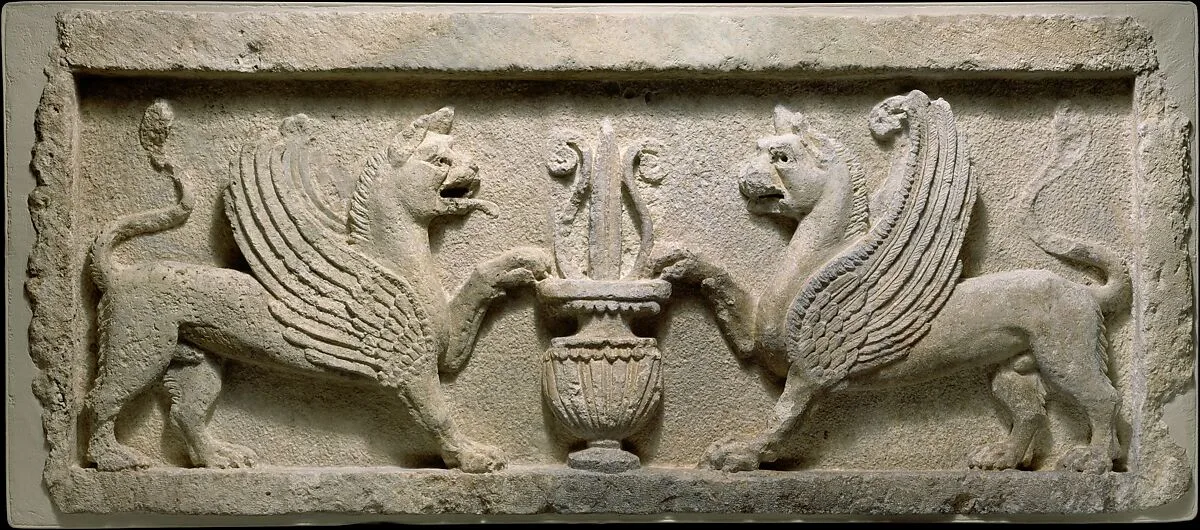
The border between the western empire of Rome and the Parthian lands in the east ran between the central and northern Euphrates and Tigris rivers. Hatra in northern Iraq, southwest of modern Mosul, was a major trading city heavily fortified against Roman attack. Once part of a decorated doorway in the Great Iwans, the main temple building at the heart of the Great Temple enclosure at Hatra, this lintel stone was originally positioned so that the carved surface faced the floor. The two fantastic creatures have feline bodies, long ears, wings, and crest feathers—a combination of animal and bird elements typical of Near Eastern lion-griffins. Between the two figures is a vase containing a stylized lotus leaf and two tendrils. The naturalistic modeling of the creatures' bodies and the form of the central vase reflect Roman influence. However, the absolute symmetry of the composition, the pronounced simplification of the plant forms, and the lion-griffin motif are all characteristic of the Near East.
- Artist
- Unknown
- Date
- ca. 2nd–early 3rd century CE
- Medium
- Limestone
- Culture
- Parthian
- Department
- Ancient Near Eastern Art
- Credit line
- Purchase, Joseph Pulitzer Bequest, 1932