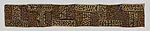
Woman's Ceremonial Underskirt
Unknown
20th century · Raffia palm fiber · Arts of Africa, Oceania, and the Americas

Sixteen feet in length, this densely patterned ncák was designed to expand its wearer’s bodily presence. It was worn wrapped around a woman’s lower body three to four times and then tucked or secured with a belt. The production of raffia fiber garments is a collaborative venture that instantiates clan relationships. Production begins with the cultivation of raffia palms and the weaving of mbala (unadorned rectangular textile panels) on single-heddle looms. These are then arranged and decorations applied by female family members of various ages. The female head of the clan typically coordinates the work by selecting the style of the skirt, acquiring the necessary units of mbala, and outlining the embroidery patterns. The resulting garment is considered clan property.
- Artist
- Unknown
- Date
- 20th century
- Medium
- Raffia palm fiber
- Culture
- Kuba peoples
- Department
- Arts of Africa, Oceania, and the Americas
- Credit line
- Bequest of John B. Elliott, 1998