Ceremonial Sword and Sheath (Udamalore)
Yoruba artist
19th–20th century · Cotton, glass beads, wood, brass bells, rope, metal (?) · Arts of Africa, Oceania, and the Americas
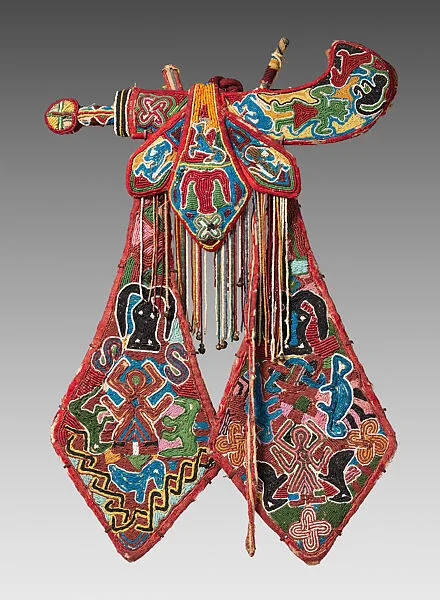
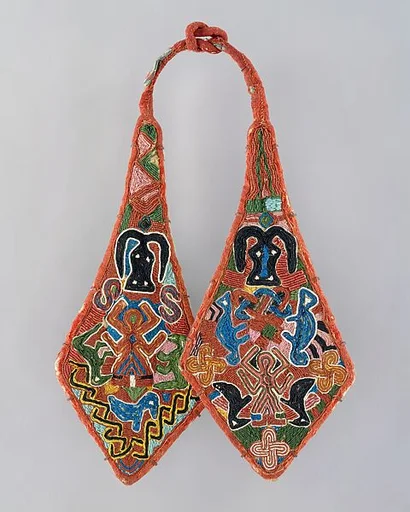
The leadership arts of Owo, an ancient Yoruba town, reflect those of Benin, the Edo kingdom that dominated Owo in the sixteenth and eighteenth centuries. This ceremonial sword and sheath (udamalore) and the matching lozenge-shaped panels (apete) recall the chiefly regalia illustrated on Benin brass plaques of the sixteenth and seventeenth centuries. The udamalore is worn by Owo chiefs on the left hip above the panels, which are hung over a belt. A voluminous wrapped skirt, tall miter-shaped hat, brass and ivory pendants and armlets, and a fan-shaped iron sword (also of Benin origin) held in the right hand complete the ceremonial attire. The udamalore sword is made of wood, and both its sheath and the panels are lavishly embroidered with brilliantly colored glass beads. Imported from Europe, the beads are a sign of wealth and status among the Yoruba. Although the beaded figures and animals are arranged symmetrically, their jagged outlines and vivid colors create a dizzying, dancing composition. The motifs--human figures, ram's heads, crouching monkeys, birds, chameleons, and other animals--refer to the protective role of the ancestors, the chief's inalienable powers and privileges, and the mystical forces that protect and strengthen the wearer of such lavish costume ornaments. This Ceremonial sword and sheath (Udamalore) is completed by the panel ornaments 1993.500.1.
- Artist
- Yoruba artist
- Date
- 19th–20th century
- Medium
- Cotton, glass beads, wood, brass bells, rope, metal (?)
- Culture
- Yoruba
- Department
- Arts of Africa, Oceania, and the Americas
- Credit line
- Gift of Dr. and Mrs. Jeffrey S. Hammer, in memory of William B. Fagg, 1993