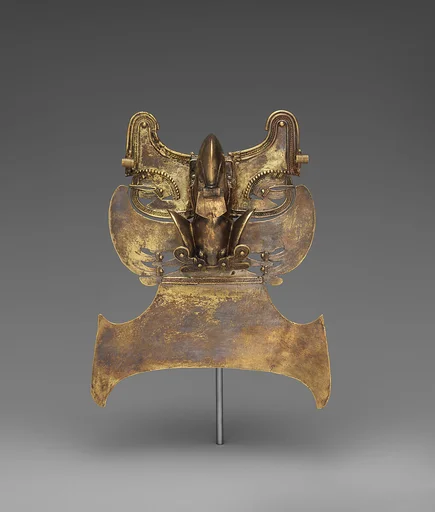
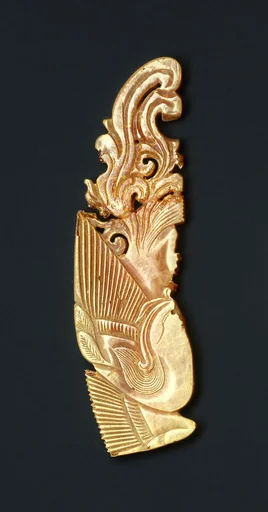
Bird Spatula
Unknown
11th–16th century · Gold · Arts of Africa, Oceania, and the Americas
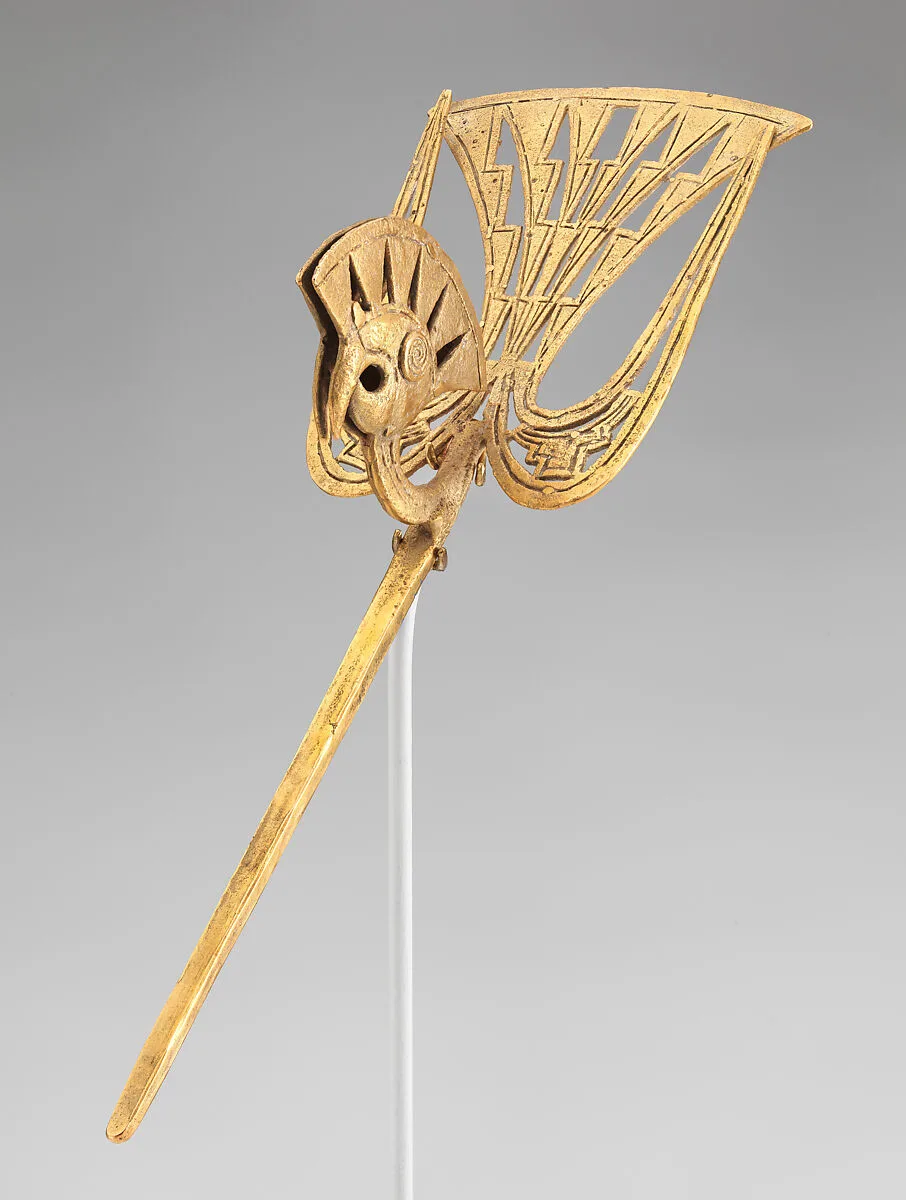
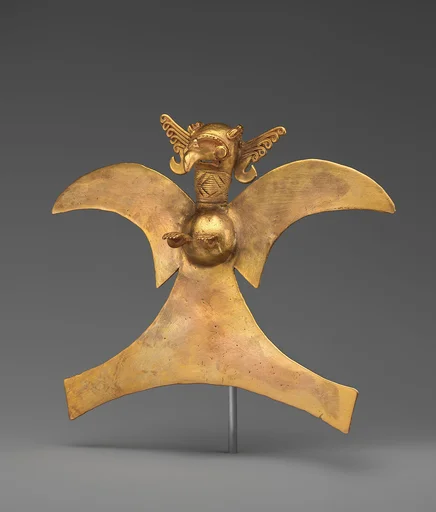
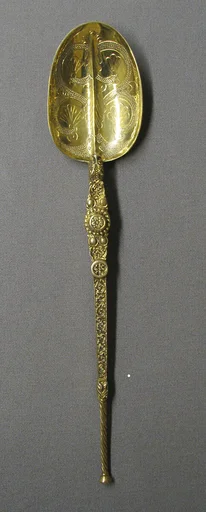
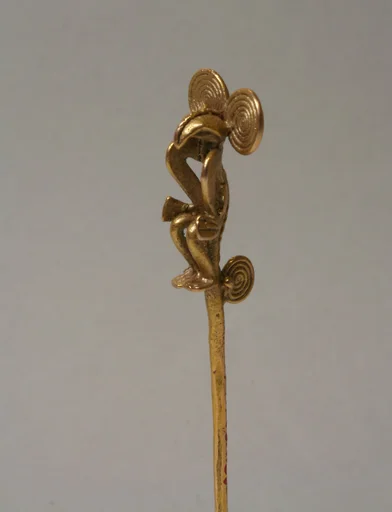
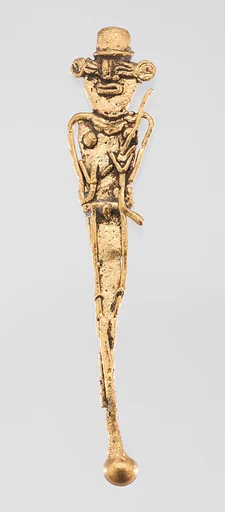
The area near the town of Popayán in the upper Cauca River area of Colombia has produced a number of handsome gold objects that are not related to any other styles. Of considerable visual appeal and superior craftsmanship, the elegant works are invariably cast of tumbaga; their surfaces were enriched by the depletion gilding method, also known as mise-en-couleur. Bird imagery is pervasive in the goldwork of Precolumbian America. Isthmian eagle pendants, with their characteristic frontal pose, are particularly well known, and different versions of the spread-wing-and-tail type come from Colombia as well. Here the artist has found an innovative way to depict the bird in full flight. Visualized from above, the bird appears to dive, its spread tail and wings forming a linear openwork pattern, perhaps to indicate feathers and to convey a sense of lightness. The bird's head, atop a strongly curved neck, has a fanned-out crest and strong beak that recalls a parrot. The bird adorns the top of a lime spatula that has an unusually short shaft. Spatulas were used to take powdered lime from a container and to add it to coca leaves for chewing. Coca chewing is a very ancient tradition in Andean South America and the paraphernalia for it could be elaborate and precious.
- Artist
- Unknown
- Date
- 11th–16th century
- Medium
- Gold
- Culture
- Popayan
- Department
- Arts of Africa, Oceania, and the Americas
- Credit line
- Jan Mitchell and Sons Collection, Gift of Jan Mitchell, 1991