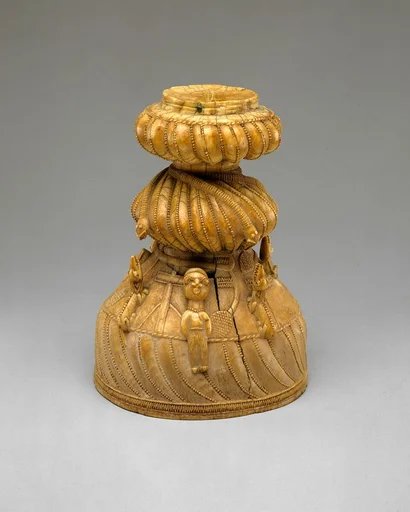
Lidded Saltcellar
Sapi-Portuguese artist
15th–16th century · Ivory · Arts of Africa, Oceania, and the Americas
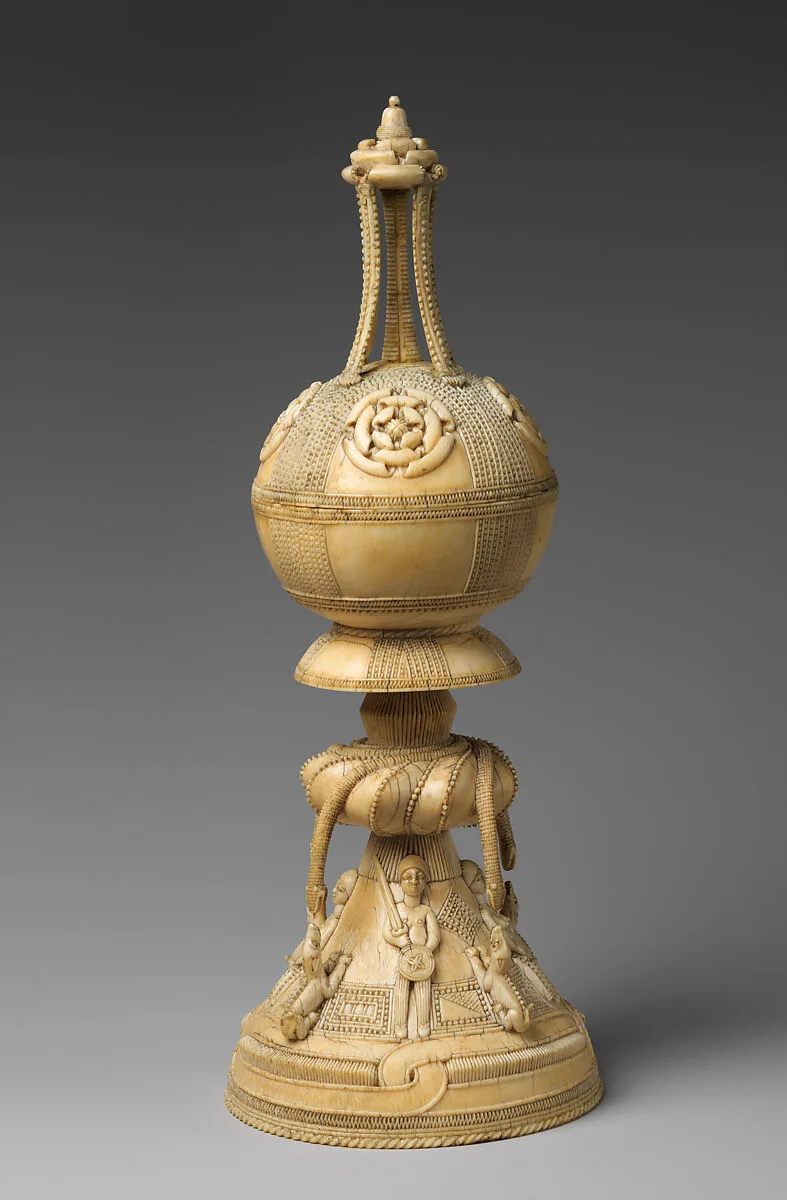
This saltcellar is both an extraordinary example of skilled workmanship and an artifact that epitomizes a singularly important convergence of cultures. In the second half of the fifteenth century, Portuguese explorers and traders were impressed by the considerable talent of ivory carvers along the coast of West Africa. As a result, they were inspired to commission works of this kind for their patrons, which ingeniously combine both European and African aesthetics and forms. During this period, salt and pepper were costly commodities and elaborate receptacles were appropriate for their storage in princely homes. This work contains imagery relating to indigenous Sapi belief systems. The four snakes, associated with mystical wealth, appear to confront four growling dogs. According to regional traditions, dogs are considered spiritually astute animals able to see spirits and ghosts that are invisible to humans. This depiction of the dogs, with teeth bared, hair bristling, and ears laid back, may relate to that ability. However, the level of animation in this scene could also derive from chivalric hunting scenes in European woodcuts, which were furnished to local African artists by their European patrons.
- Artist
- Sapi-Portuguese artist
- Date
- 15th–16th century
- Medium
- Ivory
- Culture
- Sapi-Portuguese
- Department
- Arts of Africa, Oceania, and the Americas
- Credit line
- Gift of Paul and Ruth W. Tishman, 1991