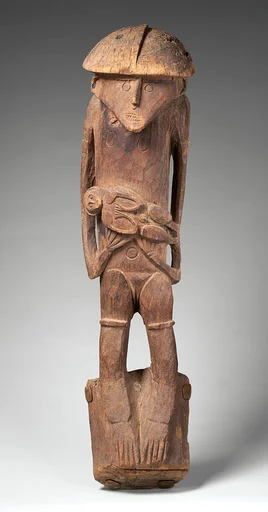
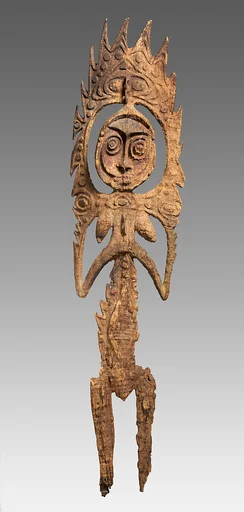
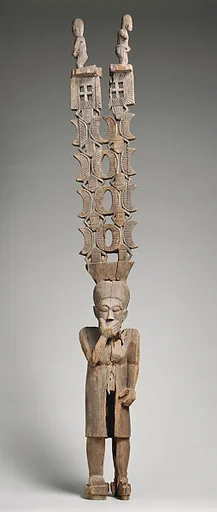
Finial for a Ceremonial House
Unknown
late 19th–early 20th century · Wood, cowrie shells, paint · Arts of Africa, Oceania, and the Americas
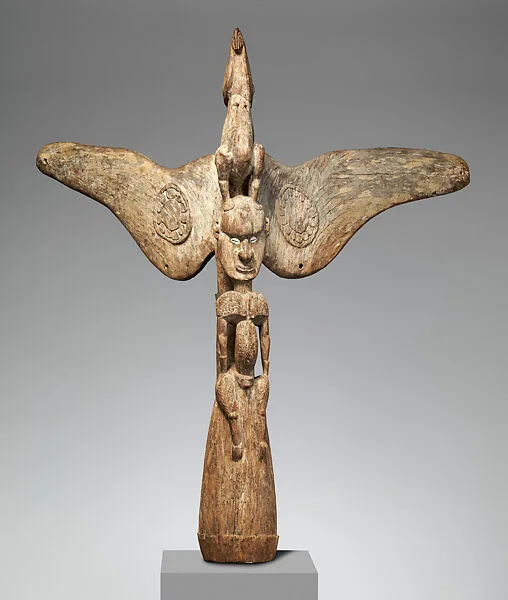
The art of the Sawos, Iatmul, and neighboring peoples in the Middle Sepik region of northeastern New Guinea is primarily associated with their impressive men’s ceremonial houses, which are seen as the embodiments of primordial female ancestors. The triangular gables at either end of Sawos and Iatmul men’s houses rise into steep peaks crowned by separately carved wood finials that depict human figures with birds, usually eagles, perched above them. Local interpretations of this imagery vary. In some instances, the human images are said to represent enemies subdued by the power of the village’s totemic beings. In this interpretation, the bird symbolizes the village’s martial strength, which in former times assured victory in war. According to other accounts, the finial images represent the dual nature of the primordial bird-men and bird-women, who originally created the sacred musical instruments, consisting of bamboo flutes and slit gongs that were kept within the ceremonial houses and played a central role in ritual life.
- Artist
- Unknown
- Date
- late 19th–early 20th century
- Medium
- Wood, cowrie shells, paint
- Culture
- Sawos people
- Department
- Arts of Africa, Oceania, and the Americas
- Credit line
- The Michael C. Rockefeller Memorial Collection, Bequest of Nelson A. Rockefeller, 1979