Spirit Canoe (Wuramon)
Unknown
mid-20th century · Wood, paint, sago palm leaves · Arts of Africa, Oceania, and the Americas

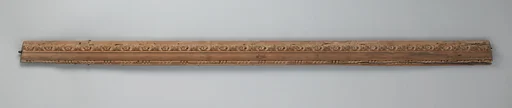
Asmat spirit canoes (wuramon) are ceremonialcarvings in the form of supernatural vessels. Wuramon are created for a one-time use during emak cem (the bone house feast), a ceremony that celebrates the spirits of the recently dead and the initiation of young boys. After being secluded within a ritual house for several months, the boys emerge one by one and crawl across the wuramon on their bellies. As each crosses the vessel, he is transformed from a boy into a man. Once across, he is seized by a man who cuts designs into his body; these heal into permanent scarification patterns that mark him as an adult. Crewed by spirits, the wuramon has no bottom to its hull, as spirits do not require a complete hull for their journey. The spirit figures have a dual nature: their outer forms portray supernatural creatures, but each is named for a specific recently deceased ancestor, whose spirit it embodies. A turtle (mbu), a fertility symbol because of the numerous eggs it lays, appears near the center of this wuramon. Behind it is an okom, a dangerous Z-shaped water spirit. The other figures, gazing down through the bottomless hull, represent menacing water spirits (ambirak) or human-like spirits (etsjo). A hammerhead shark is depicted on the prow.
- Artist
- Unknown
- Date
- mid-20th century
- Medium
- Wood, paint, sago palm leaves
- Culture
- Asmat
- Department
- Arts of Africa, Oceania, and the Americas
- Credit line
- The Michael C. Rockefeller Memorial Collection, Bequest of Nelson A. Rockefeller, 1979