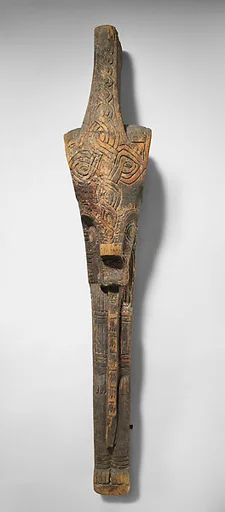
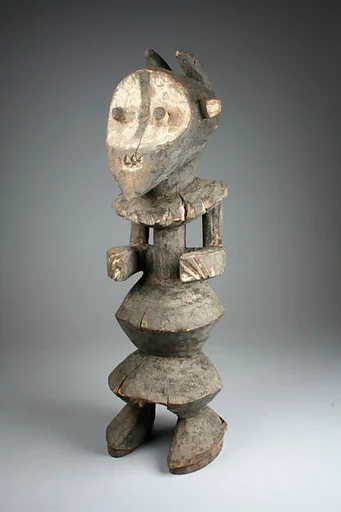
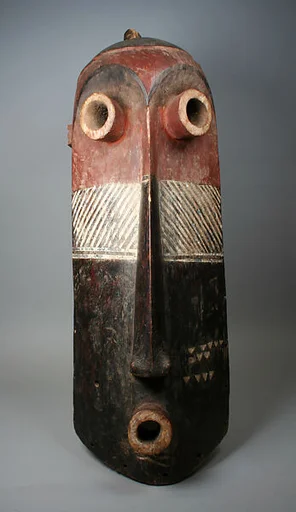
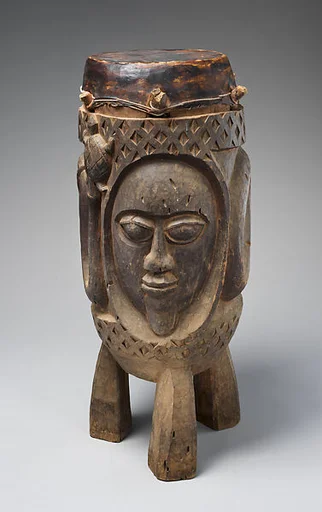
House Post Figure
Unknown
19th century · Wood · Arts of Africa, Oceania, and the Americas
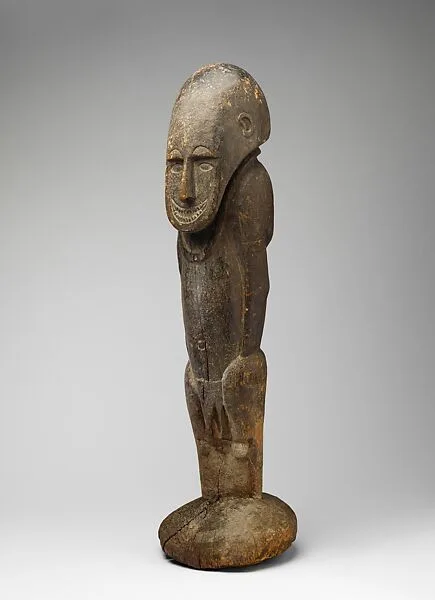
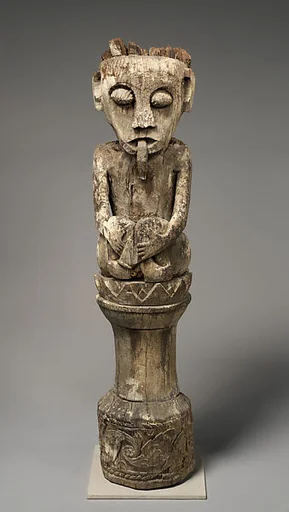
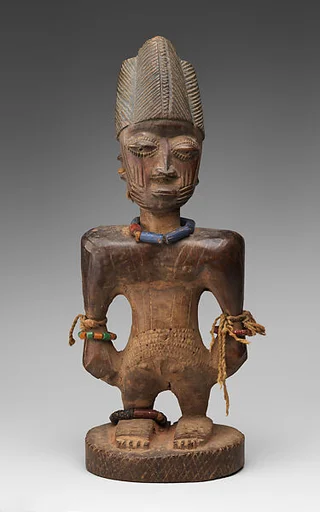
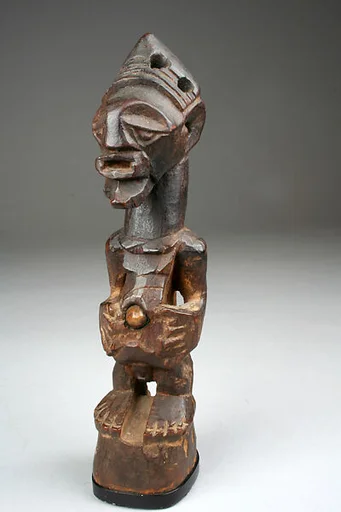
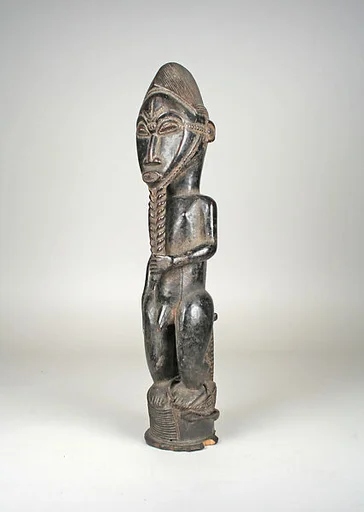
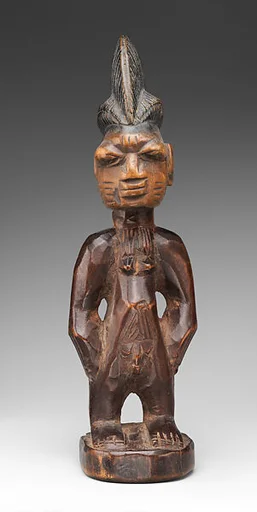
In the past, the grandest structures in most villages of the Sentani people of Lake Sentani in northwest New Guinea were the houses of hereditary chiefs. Like all Sentani dwellings, they were built over the water and were supported by wood pilings. Chiefs' houses were lavishly decorated with architectural carvings of two basic types: house post figures, such as the present work, which adorned the tops of the pilings that supported the floor, and tall Y-shaped posts, which supported the central roof beam. Likely depicting an important clan ancestor, this image once adorned the top of a Sentani house post. When in use, the lower portion of the post was embedded in the lake-bed and the carved image protruded through the floor of the house. In Sentani oral tradition, the first ancestors lived underground and emerged to populate the earth. The placement and imagery of the posts, whose ancestral figures rose from the earth to emerge through the floor of the dwelling, may have been a symbolic reference to that story. Left: House Post Figure Sentani people, probably Kabiterau village, Lake Sentani, New Guinea, Papua (Irian Jaya) Province, Indonesia, 19th century Wood The Michael C. Rockefeller Memorial Collection, Bequest of Nelson A. Rockefeller, 1979 (1979.206.1440) Ex coll.: Pierre Loeb, Paris, collected by Jacques Viot in 1929 Right: House Post Figure Sentani people, Lake Sentani, New Guinea, Papua (Irian Jaya) Province, Indonesia, 19th century Wood The Michael C. Rockefeller Memorial Collection, Bequest of Nelson A. Rockefeller, 1979 (1979.206.1444) Ex coll.: Jacques Viot, Paris, collected 1924-29 New Guinea: Lake Sentani The Sentani people live in villages built out over the waters of Lake Sentani, a large lake just inland from Humboldt Bay on the northwest coast of New Guinea. Constructed on wood pilings, houses and other structures in Sentani villages are linked together by boardwalks, allowing the residents to reach any part of the village without the use of canoes. Until the early 1920s, the most imposing structures in Sentani villages were the houses of the ondoforo, hereditary chiefs who were both the political and religious leaders of society. Although ordinary dwellings were unadorned, the houses of the ondoforo often were lavishly decorated with architectural sculpture. The Sentani also had a rich tradition of decorative art, creating beautifully decorated bowls, canoes, paddles, bark cloth, and personal accessories, which often were decorated with distinctive S-shaped spirals. The imagery of Sentani art often shows close stylistic affinities with that of the peoples of Humboldt Bay, with whom they regularly interacted.
- Artist
- Unknown
- Date
- 19th century
- Medium
- Wood
- Culture
- Sentani people
- Department
- Arts of Africa, Oceania, and the Americas
- Credit line
- The Michael C. Rockefeller Memorial Collection, Bequest of Nelson A. Rockefeller, 1979