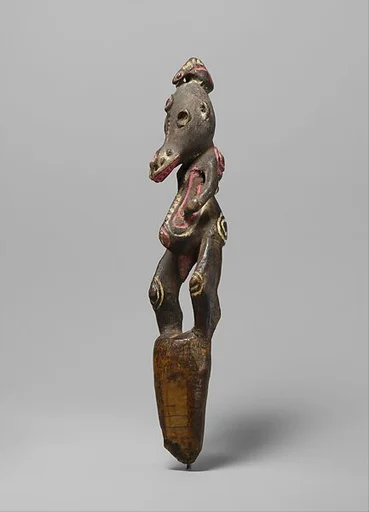
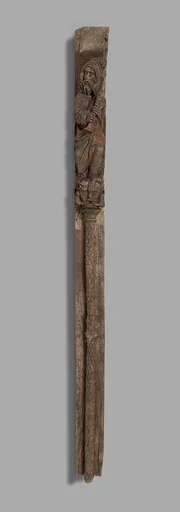
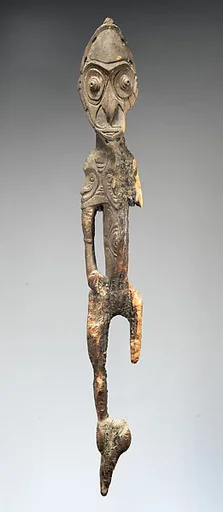
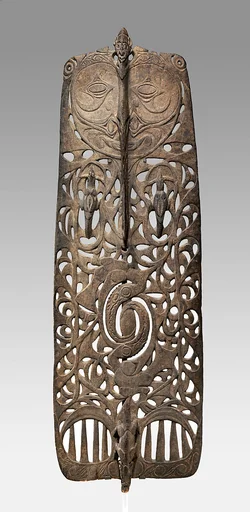
Flute Mask
Unknown
late 19th–early 20th century · Wood, paint, seeds, fiber · Arts of Africa, Oceania, and the Americas
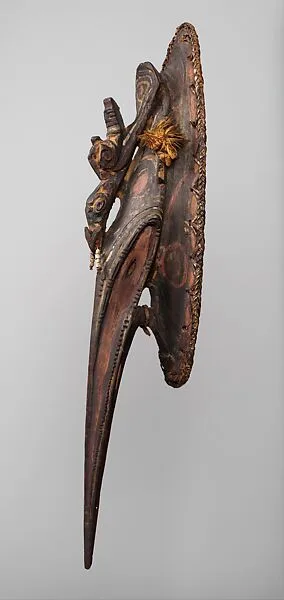
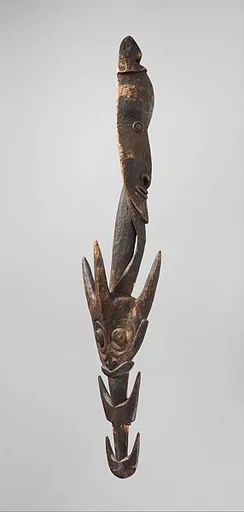
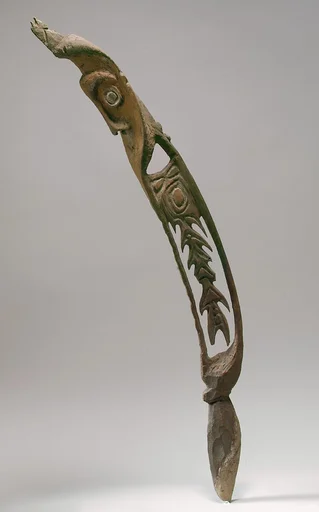
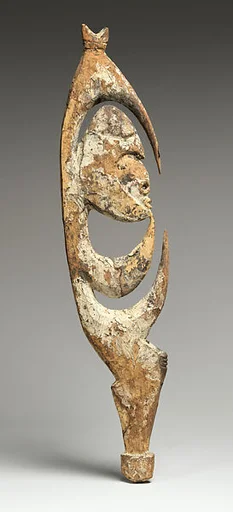
Masks in the Sepik region of northeast New Guinea were not always created to be worn on the face. Many groups create, or created, flute masks, such as this example from the Kopar people who live along the lower reaches of the Sepik River. They served as ornaments for sacred flutes, which were important ceremonial instruments in many parts of New Guinea. Masks with long beak-like noses appear widely in Lower Sepik art and predominantly depict powerful spirits. These noses find their supreme expression in Kopar masks, in which the facial features are almost entirely condensed onto a central spike-like nose. Some examples are crowned, as here, by a small bird, possibly representing an eagle, probably a totemic species associated with one of the village clans.
- Artist
- Unknown
- Date
- late 19th–early 20th century
- Medium
- Wood, paint, seeds, fiber
- Culture
- Angoram or Kopar people
- Department
- Arts of Africa, Oceania, and the Americas
- Credit line
- The Michael C. Rockefeller Memorial Collection, Bequest of Nelson A. Rockefeller, 1979