Canoe Prow
Unknown
19th–early 20th century · Wood, cowrie shells · Arts of Africa, Oceania, and the Americas
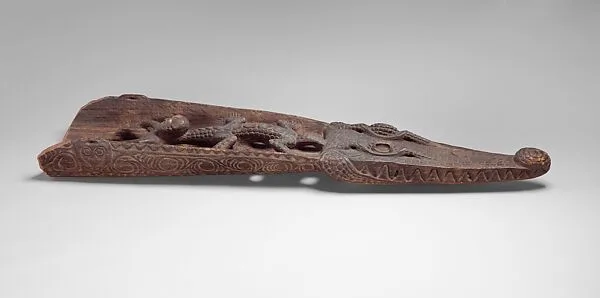
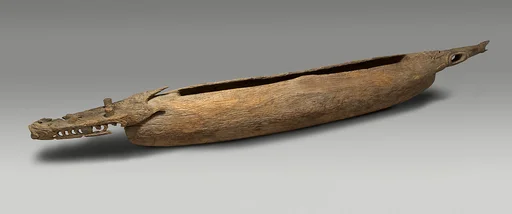
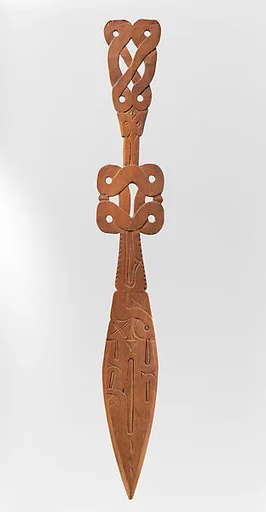
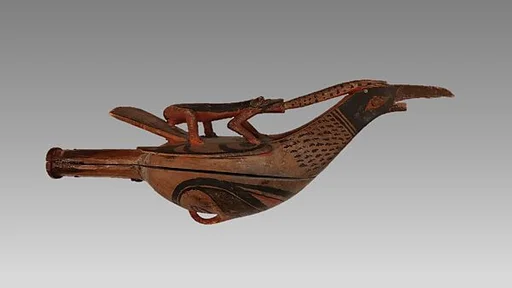
Crocodiles play a central role in the art and culture of the Iatmul people. According to one Iatmul creation account, an ancestral crocodile was responsible for forming the land. In the beginning, the earth was covered by a primordial ocean, into whose depths the crocodile dived. Reaching the bottom, it brought up on its back a load of mud, which became an island when it surfaced. From that island, the land grew and hardened, but it continues to rest on the back of the ancestral crocodile, which occasionally moves, causing earthquakes. Both now and in the past, the prows of most sizeable canoes are carved, as here, in the form of a crocodile. The scale of the present work indicates that it probably adorned a large war canoe, capable of holding from fifteen to twentyfive men. These large canoes, hollowed from a single massive log, were also used for trading and fishing expeditions. Although canoes are no longer used in warfare, contemporary Iatmul carvers continue to make large examples for use in trade and general transportation.
- Artist
- Unknown
- Date
- 19th–early 20th century
- Medium
- Wood, cowrie shells
- Culture
- Iatmul people
- Department
- Arts of Africa, Oceania, and the Americas
- Credit line
- The Michael C. Rockefeller Memorial Collection, Purchase, Nelson A. Rockefeller Gift, 1955