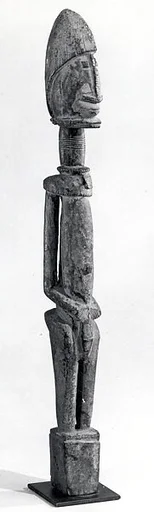
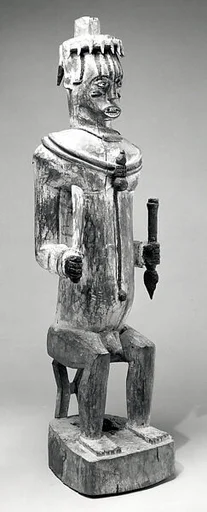
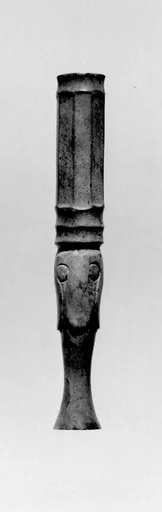
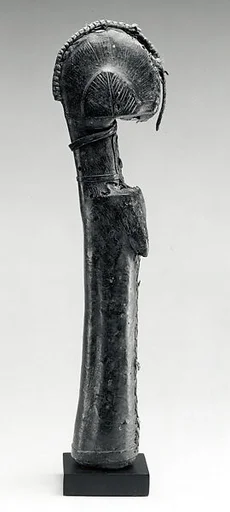
Figure from a Reliquary Element: Seated Male (Nlo Bieri)
Unknown
19th–20th century · Wood, metal · Arts of Africa, Oceania, and the Americas
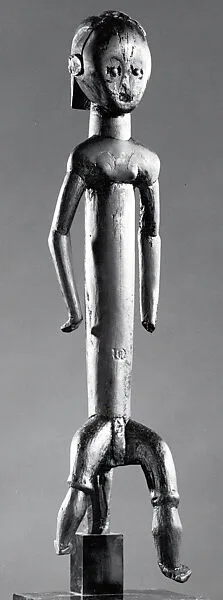
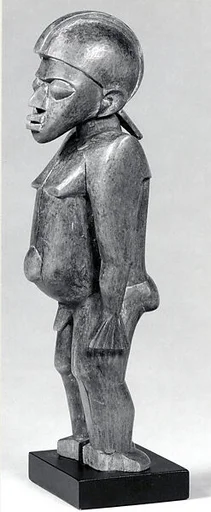
In the dense rain forests of the Republic of the Congo, Gabon, Equatorial Guinea, and southern Cameroon, a widespread belief among the Bantu-speaking peoples in the spiritual power of ancestral relics underlies the creation of remarkable works of art. Historically, the Fang peoples have derived a sense of continuity with their past and achieved communal cohesiveness in the present through an ancestral cult known as bieri. Over three centuries, a southwesterly migration into present-day southern Cameroon and northern Gabon has occurred village by village, resulting in the loosely structured, fluid nature of Fang society today. During its travels, each Fang family carried a bark box containing the skulls of its ancestors. A carved-wood head or figure mounted on top of the box guarded the sacred contents against the forbidden gazes of women and uninitiated boys. The earliest reliquary guardians are believed to be heads, but by the beginning of the twentieth century, busts and full figures were also being made. By the 1950s the role of bieri in Fang culture had been replaced by a syncretic religion known as bwiti. Bieri figures exemplify the qualities the Fang admire in people: tranquility, vitality, and the ability to hold opposites in equilibrium. These ideals are exhibited in the balanced forms of the figures. The large head of an infant is juxtaposed with the fully developed body of an adult, and a static, symmetrical pose and passive, tranquil facial expression are counterbalanced by the tension of bulging muscles.
- Artist
- Unknown
- Date
- 19th–20th century
- Medium
- Wood, metal
- Culture
- Fang peoples
- Department
- Arts of Africa, Oceania, and the Americas
- Credit line
- The Michael C. Rockefeller Memorial Collection, Gift of the IBM Corporation, 1966