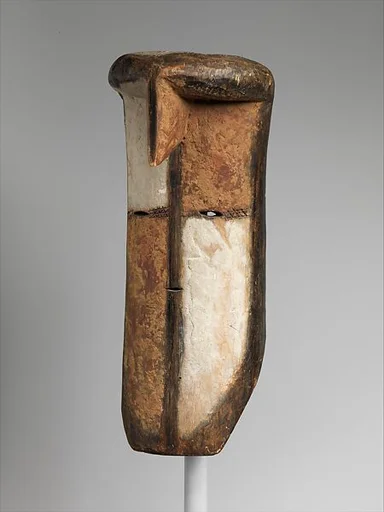
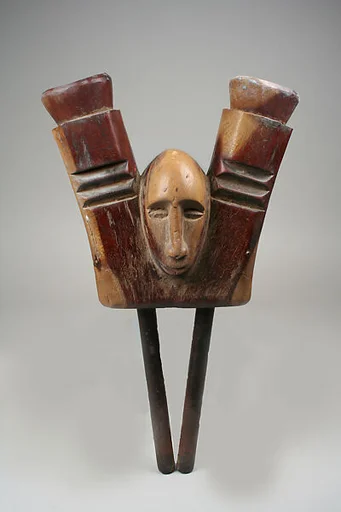
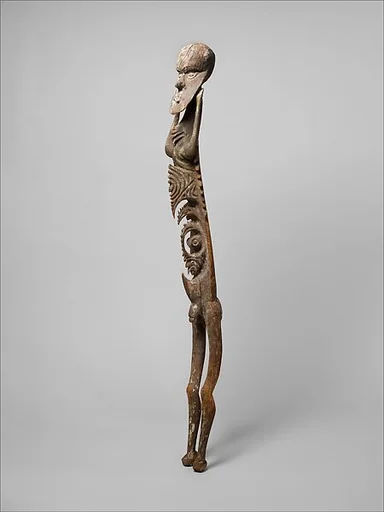
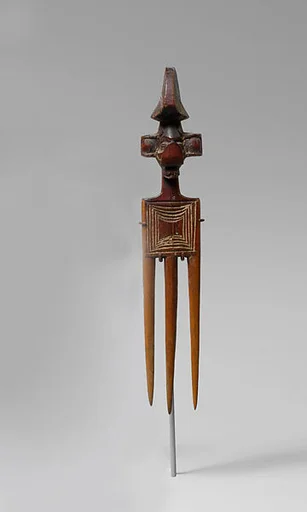
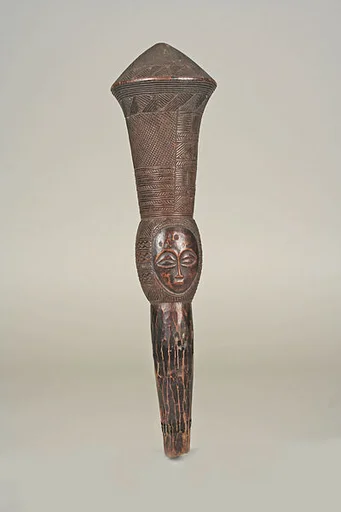
Beete Mask: Elephant (Zok)
Unknown
19th–20th century · Wood, pigment, kaolin · Arts of Africa, Oceania, and the Americas
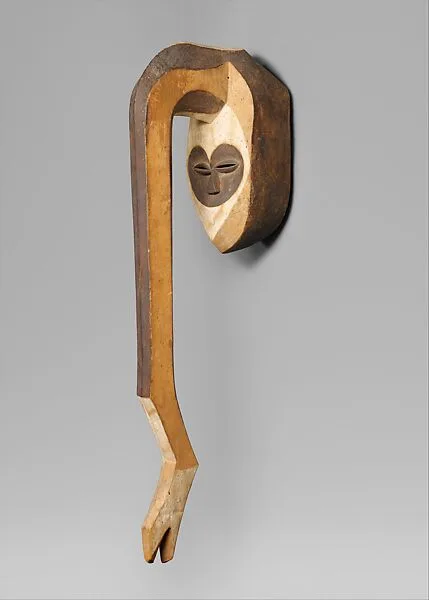
Sub-Saharan peoples south of an imaginary line extending from the lower Cross River in Cameroon eastward to southern Somalia speak related languages known collectively as Bantu. Although the cradle of this linguistic family lies in the Benue Valley of Nigeria, over the centuries peoples with this heritage have come to occupy all of central Africa. The Kwele are among the Bantu-speaking peoples who live in western equatorial Africa's rain forest. During the precolonial era, inhabitants of the region adhered to a highly diffuse notion of territoriality. Loose clusters of village settlements composed of lineage groups were easily disrupted by internal antagonisms that led to the founding of new communities. To mitigate social fragmentation, Kwele leaders developed the rite of beete, which dissipated conflict by redirecting attention to ancestral relics owned by specific lineages. Integrated into the rite were dances led by masked performers called ekuk, or "things of the forest." Most ekuk masks bore prominent animal attributes, including the bata, or ram, mask, which was characterized by horns curved around the face. Other animal features, such as trunks and beaks, inspired Kwele artists to carve elements that project beyond a single pictorial field.
- Artist
- Unknown
- Date
- 19th–20th century
- Medium
- Wood, pigment, kaolin
- Culture
- Kwele peoples
- Department
- Arts of Africa, Oceania, and the Americas
- Credit line
- The Michael C. Rockefeller Memorial Collection, Gift of Nelson A. Rockefeller, 1964