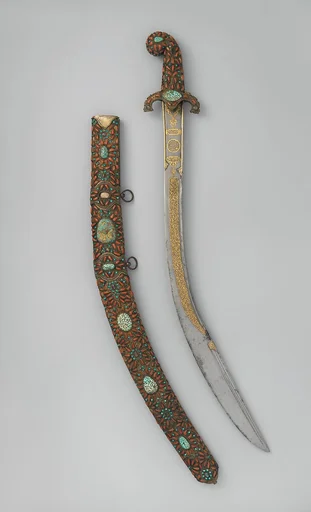
Saber with Scabbard
Unknown
grip, 18th or 19th century; guard and scabbard, 19th century; blade, dated A.H. 1099/1688 CE; decoration on blade, 19th century · Steel, gold, silver, jade (nephrite), diamonds, emeralds, pearls · Arms and Armor
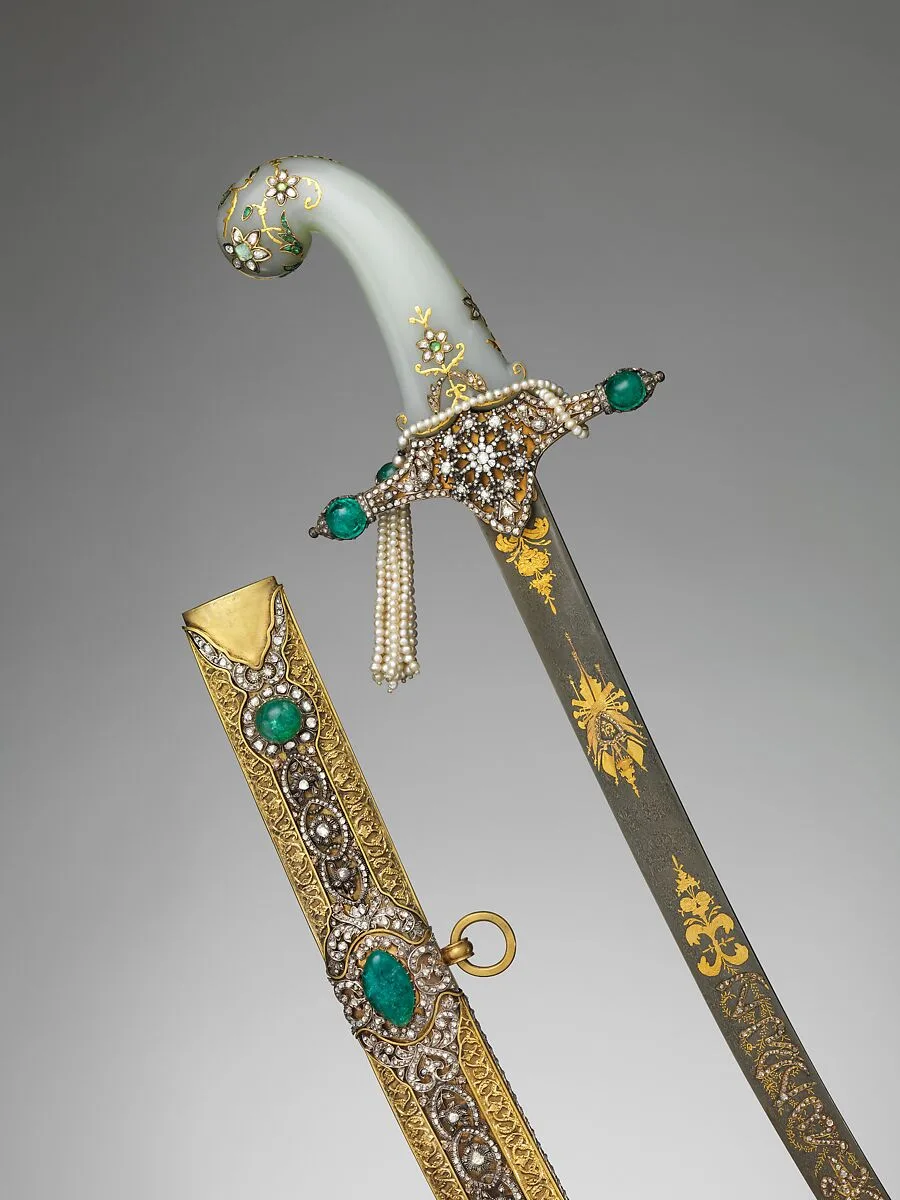
The most important ceremony in the inauguration of many Islamic rulers was the investiture with a sword, rather than a crown. This extravagantly decorated saber traditionally is said to have been refitted in 1876 for the investiture of the Ottoman sultan Murad V (reigned May 30–August 31, 1876). He suffered a nervous breakdown before the ceremony and subsequently was deposed and kept a prisoner until his death in 1904. The sword was probably assembled by a court jeweler, using a seventeenth-century Iranian blade, an eighteenth-century Indian jade grip, and gem-studded gold and gilt-brass mounts of contemporary workmanship. The emerald near the top of the scabbard opens to reveal a secret compartment containing a gold coin marked with the name of Süleyman the Magnificent (1494–1566), the most powerful Ottoman ruler of the sixteenth century. The underside of the emerald is inscribed with the phrase "According to God's will."
- Artist
- Unknown
- Date
- grip, 18th or 19th century; guard and scabbard, 19th century; blade, dated A.H. 1099/1688 CE; decoration on blade, 19th century
- Medium
- Steel, gold, silver, jade (nephrite), diamonds, emeralds, pearls
- Culture
- grip, Indian; guard, scabbard, and decoration on blade, Turkish; blade, Iranian
- Department
- Arms and Armor
- Credit line
- Gift of Giulia P. Morosini, in memory of her father, Giovanni P. Morosini, 1923