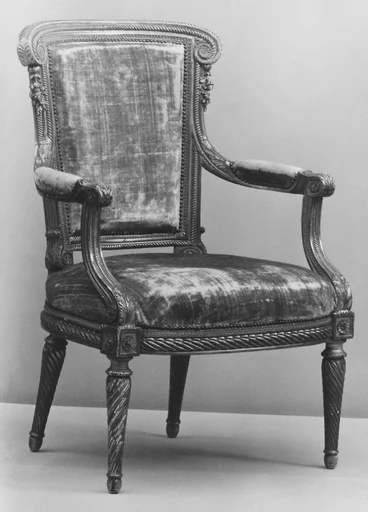
Armchair
Louis C. Tiffany|Tiffany Glass and Decorating Company
ca. 1893 · Prima vera, American ash (secondary wood); marquetry of various woods and brass; replacement upholstery · The American Wing
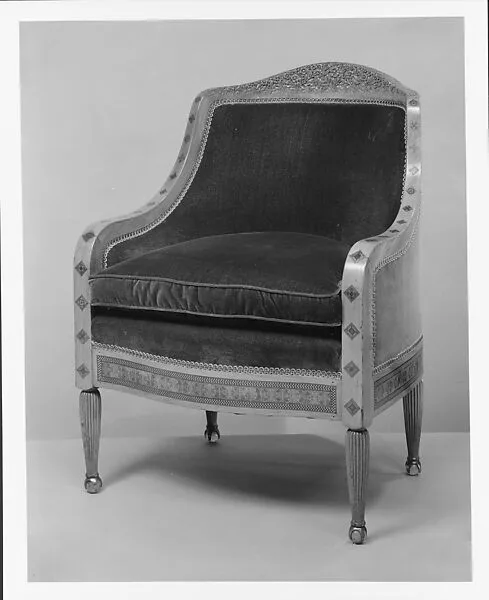
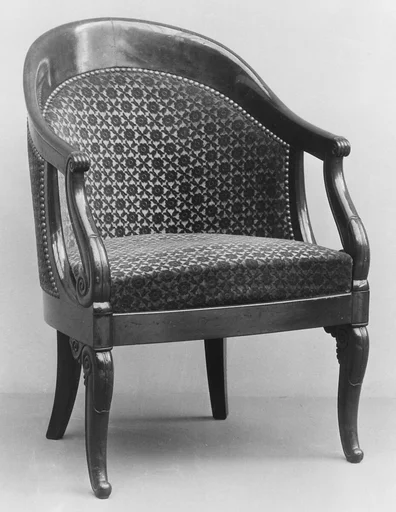
This armchair and its mate (64.202.1) were once part of a suite that included a large sofa and two smaller ladies' armchairs (Detroit Institute of Arts and The Cleveland Museum of Art). They are attributed to Louis Comfort Tiffany because of similarities shared with furniture Tiffany designed for Louisine and H. O. Havemeyer’s Fifth Avenue house in New York in 1891–92. In addition, its distinctive indigo-inspired "micro-mosaic" marquetry was discussed in a catalogue description of a "settle" displayed by the Tiffany Glass and Decorating Company at the Chicago Columbian Exposition of 1893: ". . . our wood mosaic . . . is produced by an entire new method of work. The patterns upon this piece of furniture are made of thousands of squares of natural wood, one sixteenth-of-an-inch in size, of different colors, and each individual square surrounded by a minute line of metal." This type of marquetry had been known in America prior to this, however. Harriet Prescott Spofford remarked in "Art Decoration Applied to Furniture" (1878): "No marquetry exceeds for curiosity that which is occasionally brought now from India, known as the mosaic of Bombay, and made of microscopic cubes of wood that produce a fine effect." The brass-claw and glass-ball feet are distinctive elements also used on some of the Havemeyer furniture, but they were not exclusive to Tiffany. These sophisticated chairs blend an eighteenth-century French form, known as a "bergère," with tapered reeded legs derived from early nineteenth-century designs by Thomas Sheraton. The dense floral carving on the crest is typical of late nineteenth-century "aesthetic" decoration, in which nature is transformed into a stylized surface pattern.
- Artist
- Louis C. Tiffany|Tiffany Glass and Decorating Company
- Date
- ca. 1893
- Medium
- Prima vera, American ash (secondary wood); marquetry of various woods and brass; replacement upholstery
- Culture
- American
- Department
- The American Wing
- Credit line
- Gift of Mr. and Mrs. George E. Seligmann, 1964