[Egyptian Obelisk, "Cleopatra's Needle," in Alexandria, Egypt]
Francis Frith
ca. 1870 · Albumen silver print from glass negative · Photographs
![[Egyptian Obelisk, "Cleopatra's Needle," in Alexandria, Egypt] — Francis Frith](https://d2pvxr3eb77vb4.cloudfront.net/assets/v1/32/32b7d2e5e040a65cb5ac6719e5e9c5b0321a1e79555232e95eea6d628c027ca8/full.webp)
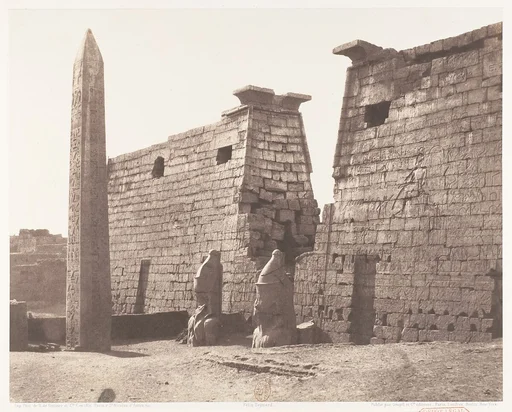
Here the Central Park obelisk sits in its late nineteenth-century environment, a neglected area of the Alexandria harbor. What this photograph did not capture was the new buildings going up nearby, indicating the harbor was undergoing modernization. It was this development that created an atmosphere in which Egyptian nationalists in 1880 argued that the obelisk should remain in Egypt as a symbol of the country’s antiquity. However, Khedive Ismail had already given the obelisk to the United States, and Henry Gorringe was quickly arranging its transportation to New York City. Frith, and later his staff, captured pictures that illustrated Egypt’s antiquity, frequently with local people as part of the scene. People who had traveled to Egypt, or perhaps only dreamed of traveling there, could choose a series of prints from the company’s stock and have them bound as a souvenir, much like Speculum Romanae Magnificentiae published some three hundred years earlier.
- Artist
- Francis Frith
- Date
- ca. 1870
- Medium
- Albumen silver print from glass negative
- Department
- Photographs
- Credit line
- Funds from various donors, 2004
![[Minaret of the Chief Mosque at Damghan, 1026–1029]](https://d2pvxr3eb77vb4.cloudfront.net/assets/v1/50/506e8ba244d2e8b3024ee11cb546ce54e01230377cb03e32a8020c6ba7d26727/graph.webp)
![[Minaret of the Mosque of 40 Columns, Chehel Dokhtar, 359b.]](https://d2pvxr3eb77vb4.cloudfront.net/assets/v1/30/30e394a2f1ee3aac1565f0bb863d279ed059002bc0e1f18bc44456439175114a/graph.webp)