Cabinet
Herter Brothers
1879–82 · Cherry, brass, and later silk textiles · The American Wing
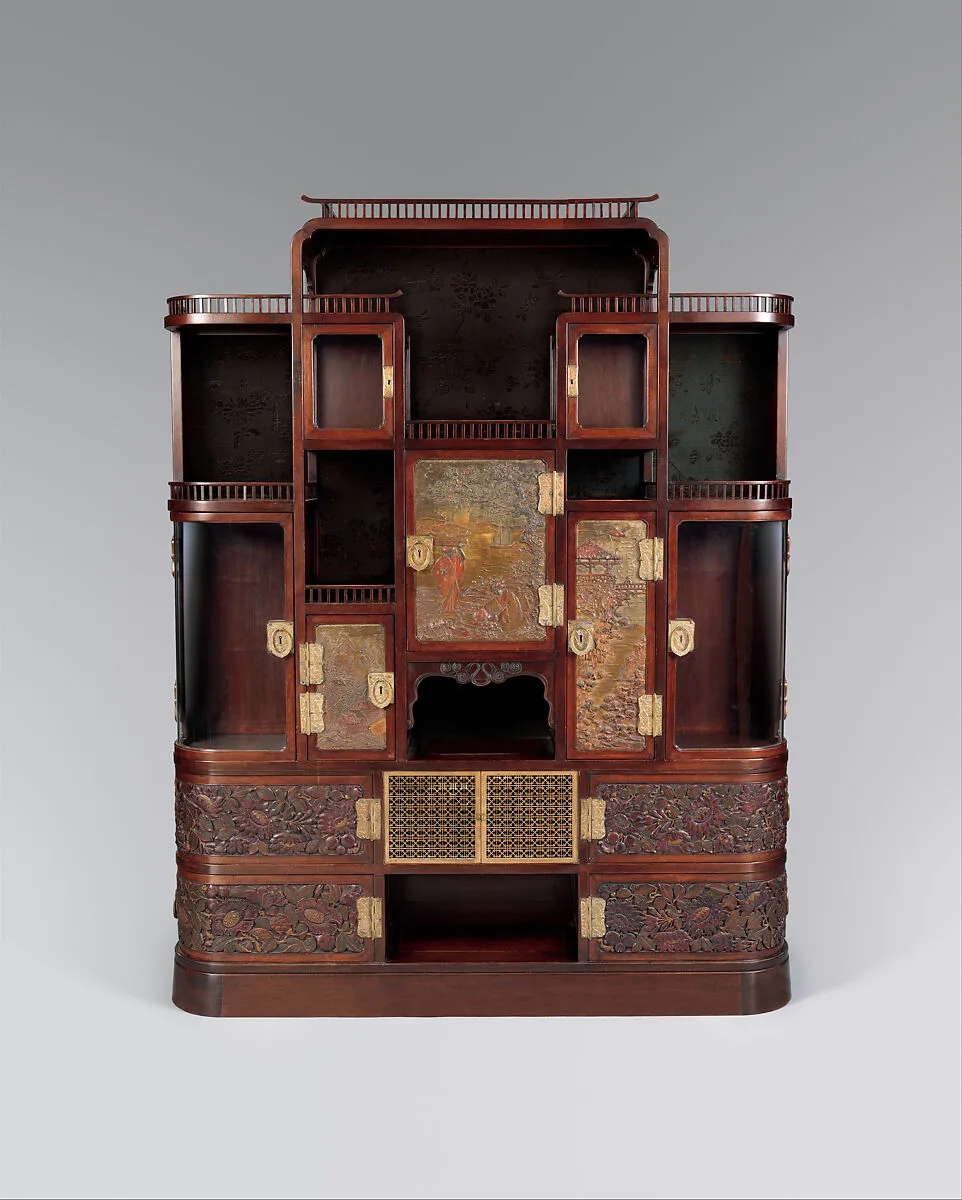
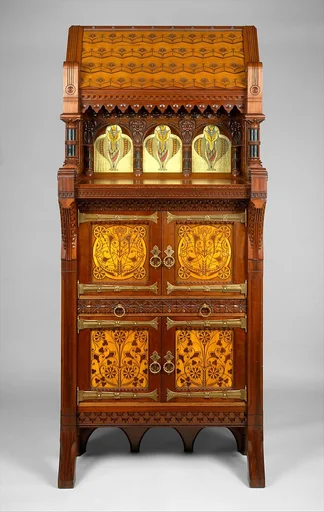
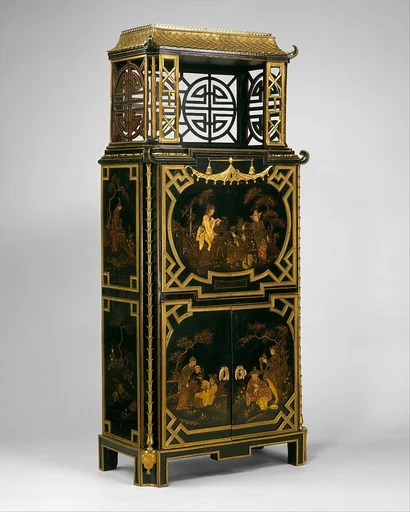
William H. Vanderbilt, son of Cornelius “Commodore” Vanderbilt, inherited a vast fortune and a lucrative transport business, which he expanded exponentially, becoming one of the wealthiest men in America. In 1879, to mark his elevated social and economic status, he built a mansion that spanned an entire city block on Fifth Avenue, between Fifty-First and Fifty-Second Streets. He commissioned Herter Brothers, one of the premier cabinetmaking firms in New York City, to decorate and furnish his home. In devising distinct decorative schemes for each room of the mansion, Herter Brothers drew inspiration from a wide range of historical styles and utilized expensive, exotic materials. Adjacent to the drawing room was the Japanese parlor. Evocative of Asian designs, the ceiling was sheathed in golden bamboo set between red lacquer beams. As summarized in “Mr. Vanderbilt’s House and Collection” (1883–84), “Japan has lent its ideas and its esthetic stamp, even where the workmanship is American.” The walls were virtually obscured by the cabinetry, a repository for a collector’s treasury, consisting of étagères with elaborate asymmetrical shelving. The bottom doors of this cabinet, stained in subtle tones of gold and red, feature low-relief carvings of stylized blossoms, leaves, and pomegranates in the manner of carved laquerwork. At the center, the three irregular metal rectangular panels depict relief scenes that echo Japanese landscape painting and are also colored red and gold.
- Artist
- Herter Brothers
- Date
- 1879–82
- Medium
- Cherry, brass, and later silk textiles
- Culture
- American
- Department
- The American Wing
- Credit line
- Gift of Barrie A. and Deedee Wigmore, 2014