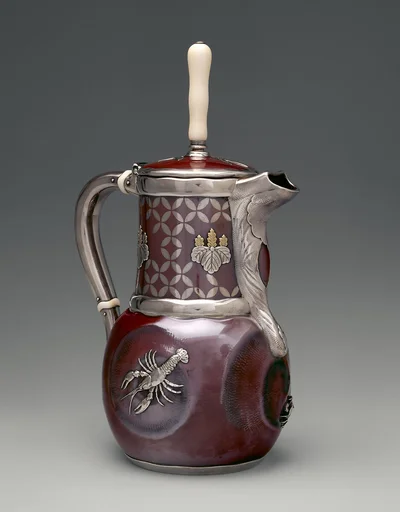
Mustard Pot
Tiffany & Co.
ca. 1879 · Silver, copper, gold, patinated copper-gold alloy, patinated copper-platinum-iron alloy, and niello · The American Wing
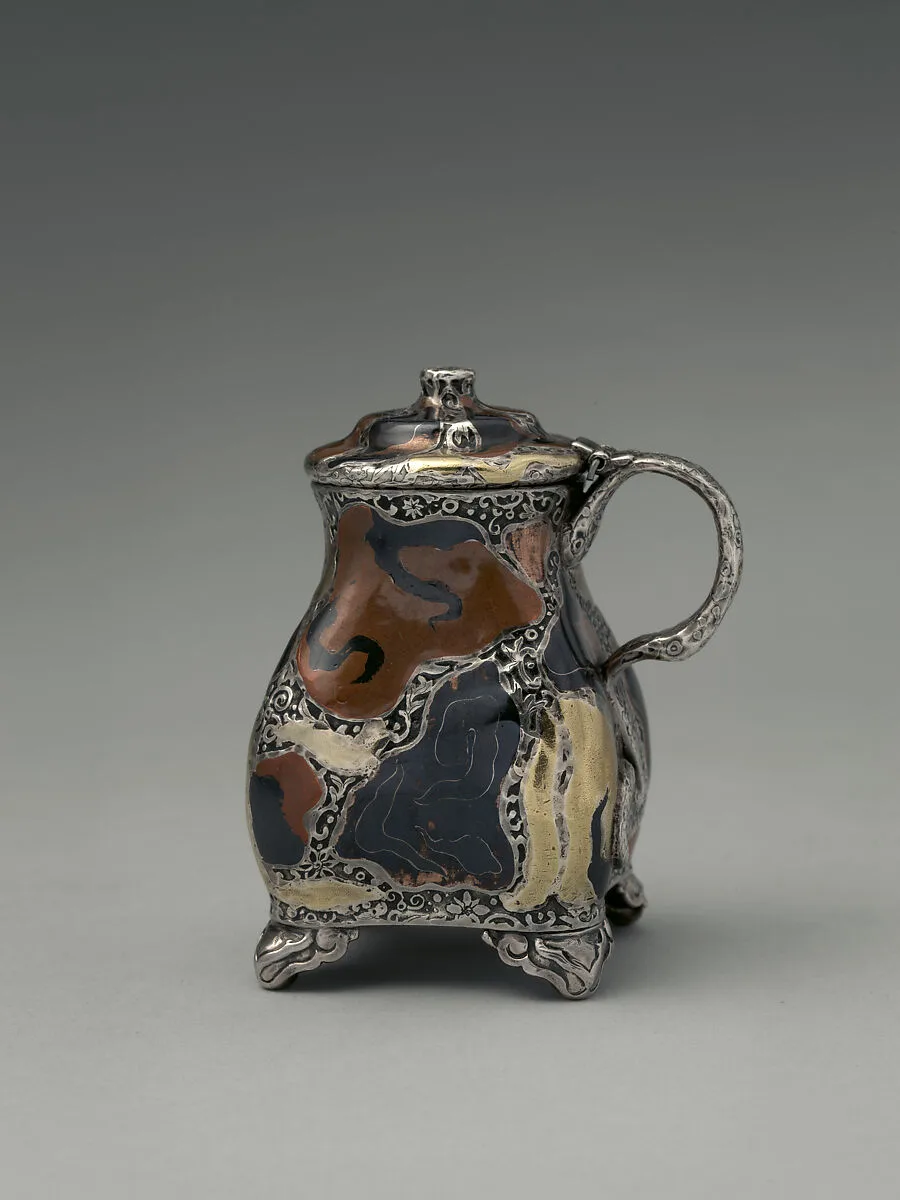
Following the opening of Japan to the West in the 1850s and the subsequent display of Japanese art at international expositions, the Japanese taste began to captivate American consumers. In response, designers such as Edward C. Moore at New York’s Tiffany & Co. introduced a range of objects inspired by Japanese art works, including ceramics, metalwork, textiles, prints, lacquerware, and netsuke. The decoration on this mustard pot is particularly unusual and innovative. Its baluster form is completely transformed by the asymmetrical inset panels of mixed metal alloys—one of patinated copper and gold (a direct attempt to imitate Japanese Shakudō), and another of patinated copper, platinum, and iron—enclosed by scrolled "Snake Skin" borders. The mottled, multicolored surface also evokes the swirling array of colors observed in Moore's collection of ancient mosaic and core-formed glass. Labeled in the Tiffany & Co. Archives as "Mustard to go with Pepper 5493," this is one of only six decorated versions produced. The Tiffany Archives also retains the Hammering & Inlaying Design drawings for this particular version (#853), which at a cost of $35 was the most expensive iteration.
- Artist
- Tiffany & Co.
- Date
- ca. 1879
- Medium
- Silver, copper, gold, patinated copper-gold alloy, patinated copper-platinum-iron alloy, and niello
- Culture
- American
- Department
- The American Wing
- Credit line
- Purchase, Friends of the American Wing Fund and Emma and Jay A. Lewis Gift, 2016