Mosaic floor with Egyptianizing scene
Unknown
ca. 130–150 CE · Stone and glass · Greek and Roman Art
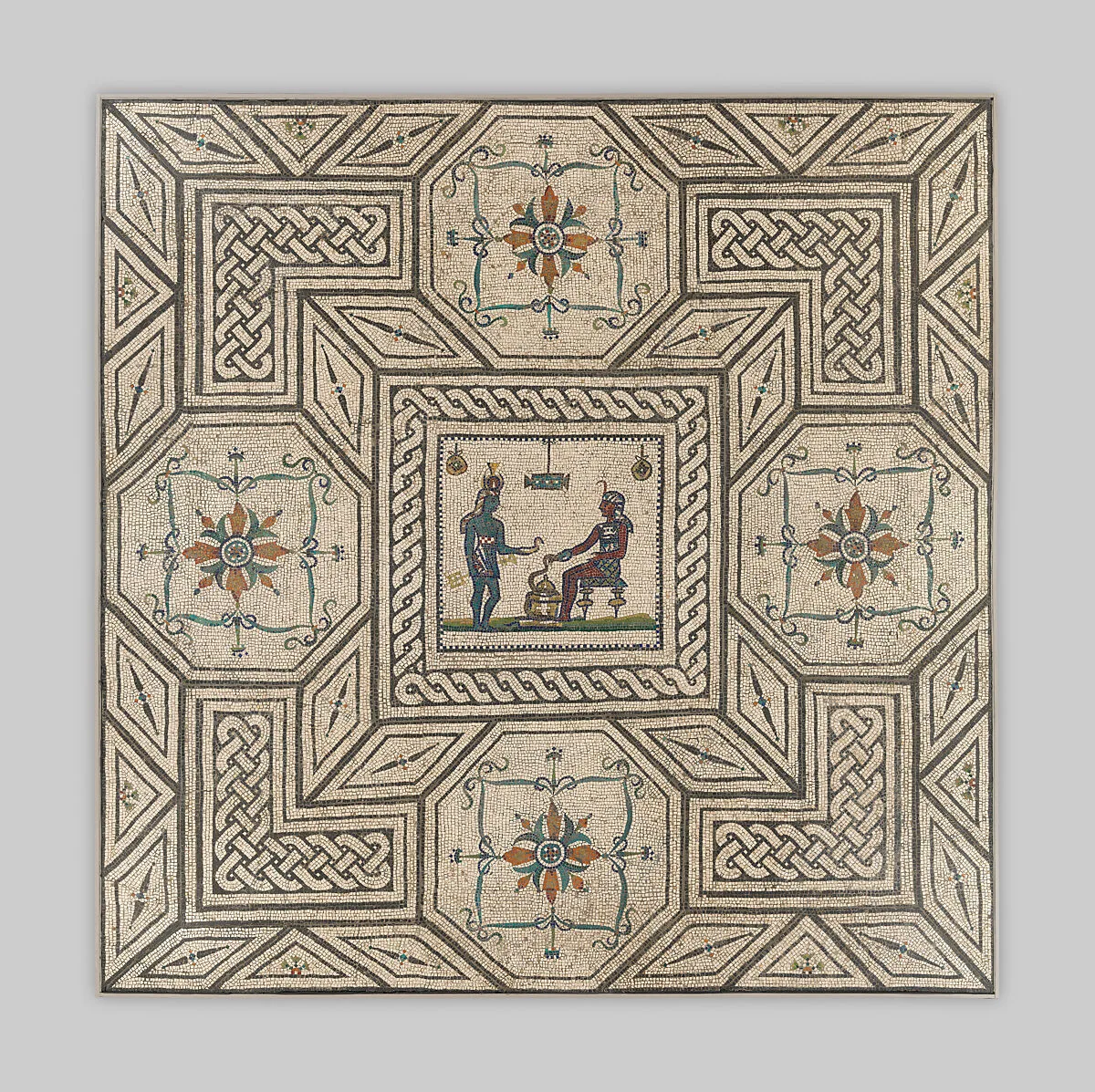
The mosaic, made of stone and glass tesserae, was found near Prima Porta, just north of Rome, in 1892. It was one of several mosaics uncovered in a villa complex. The two figures in the central panel wear Egyptian dress; the man standing on the left has been identified as a priest, making an offering to the seated figure, regarded as the goddess Isis. However, the interpretation of the scene remains problematic. Egypt held a special fascination for the Romans as a land of great wealth and antiquity, and its exotic character is often found reflected in Roman architecture, statuary, frescoes, and other decorative arts. The scene may therefore be imaginary, intended merely to convey an Egyptian atmosphere. The surrounding geometric and floral designs, on the other hand, are typically Roman. For many years the mosaic was displayed as the floor in the Boscoreale Cubiculum when it was located at the south end of the Great Hall. The mosaic was taken off displayed in 2006 when the Cubiculum was moved to its present location (Gallery 165), and it has recently been cleaned and conserved in the Sherman Fairchild Laboratory for Objects Conservation. Another mosaic, found in an adjacent room at the same villa, is exhibited in the Isabella Stewart Gardner Museum, Boston.
- Artist
- Unknown
- Date
- ca. 130–150 CE
- Medium
- Stone and glass
- Culture
- Roman
- Department
- Greek and Roman Art
- Credit line
- Gift of Susan Dwight Bliss, 1945