Fragment of the marble stele (grave marker) of a hoplite (foot soldier)
Unknown
ca. 525–515 BCE · Marble, Hymettian · Greek and Roman Art
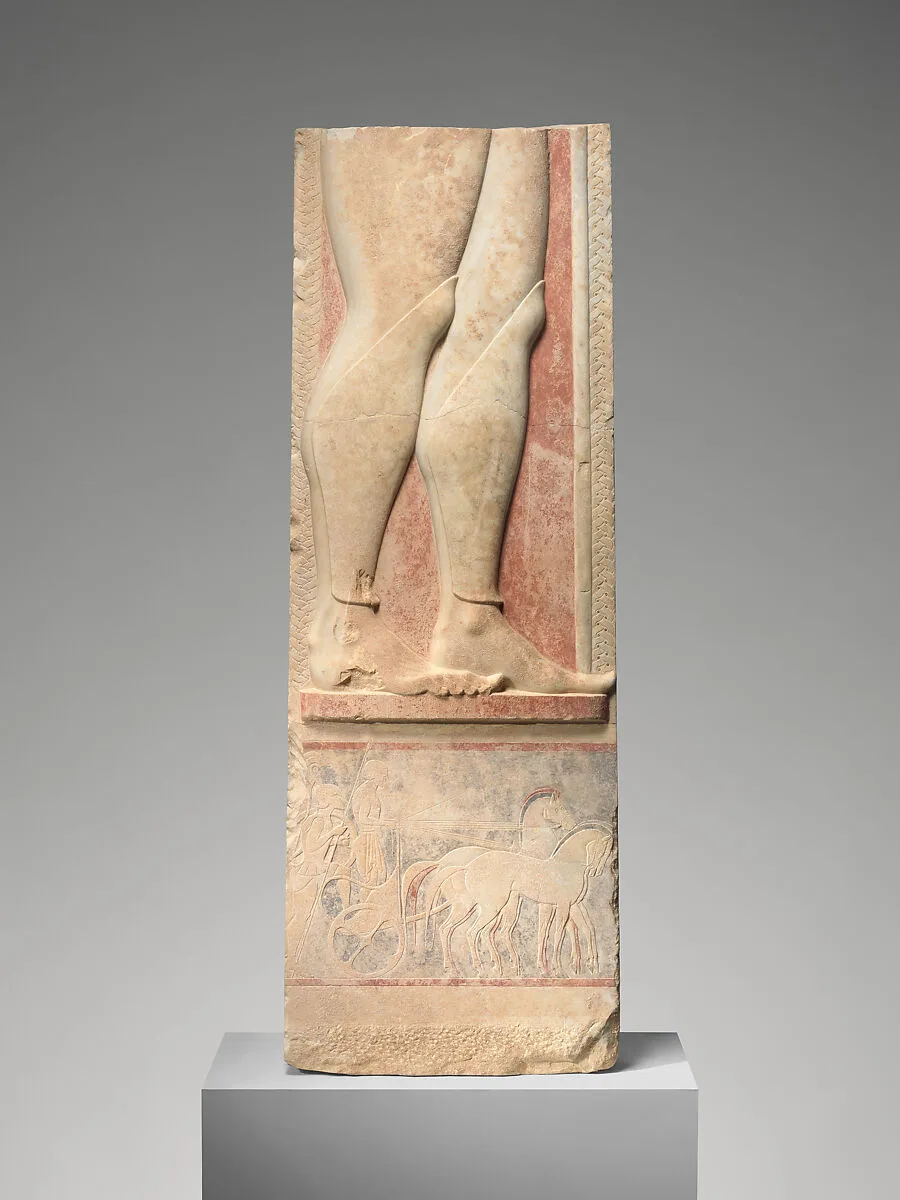
This grave marker commemorated a soldier, who was shown facing right, holding a spear. His lower legs, protected by greaves (shin guards), are preserved. The scene in the panel below shows a warrior mounting a quadriga (four-horse chariot), while his charioteer holds the reins. Such vehicles were used by the Mycenaean Greeks of the second millennium B.C. and are described by Homer in the Iliad and the Odyssey. By the Archaic period, quadrigas were no longer used in daily life. They were driven in competition, however, for the most prestigious events at Greek games were chariot races. This scene may have been intended to recall a victory of the deceased in the apobates race in which an armed runner jumped on and off a chariot, or it may evoke the family's aristocratic lineage by depicting a legendary hero departing for the Trojan War. The panel is carved in extremely low relief; the many planes were originally differentiated with red and black paint. The greaves and spear of the large-scale figure were painted blue; the background was red. Traces of red, blue, black, and green remain on the interlaced curved lines that decorate the border of the shaft.
- Artist
- Unknown
- Date
- ca. 525–515 BCE
- Medium
- Marble, Hymettian
- Culture
- Greek, Attic
- Department
- Greek and Roman Art
- Credit line
- Fletcher Fund, 1938