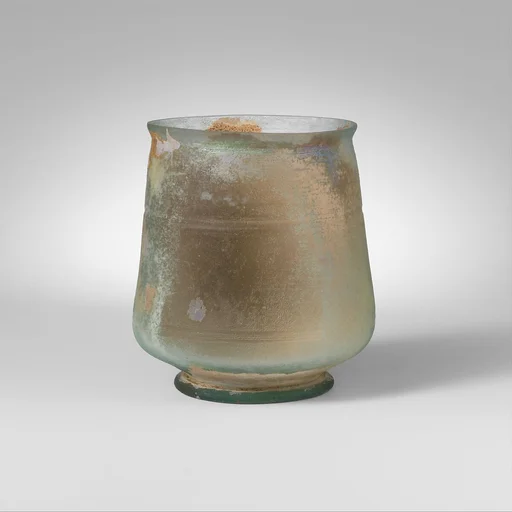
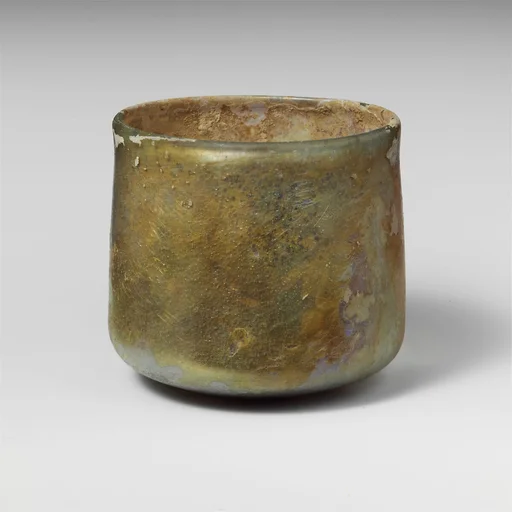
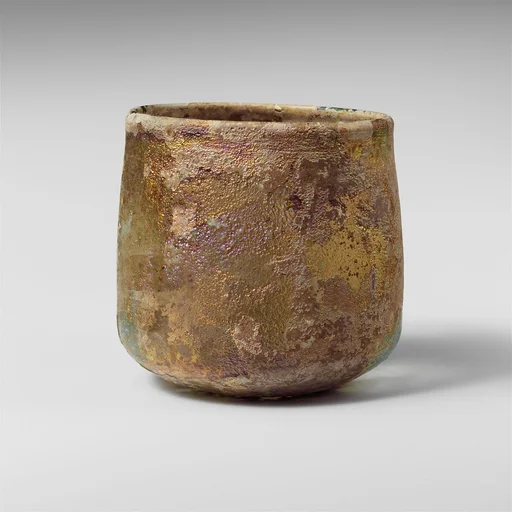
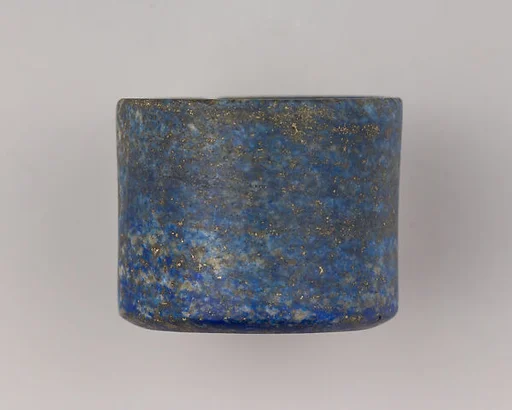
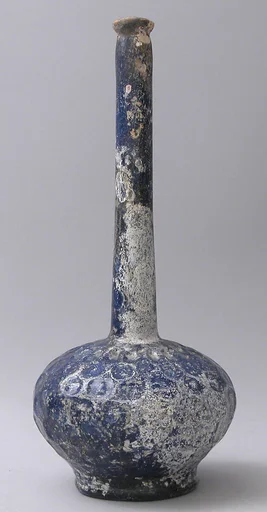
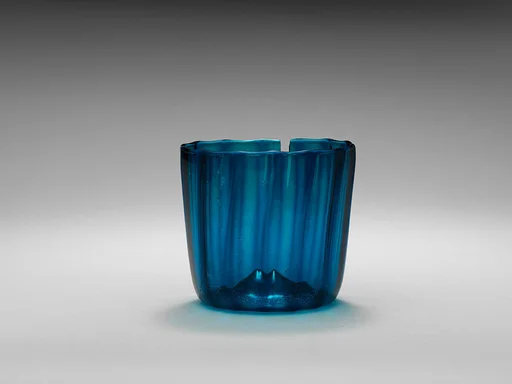
Glass cylindrical beaker
Unknown
late 1st century BCE–early 1st century CE · Glass · Greek and Roman Art
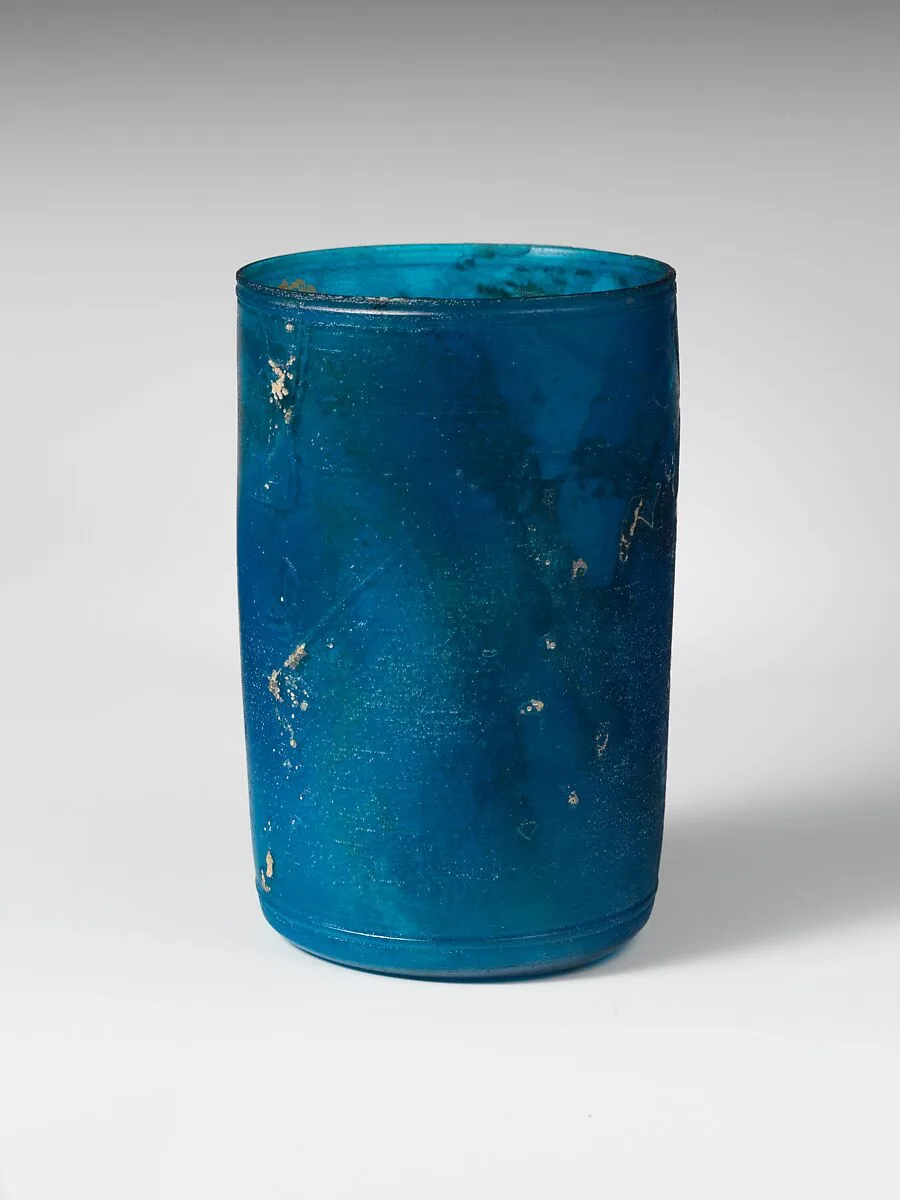
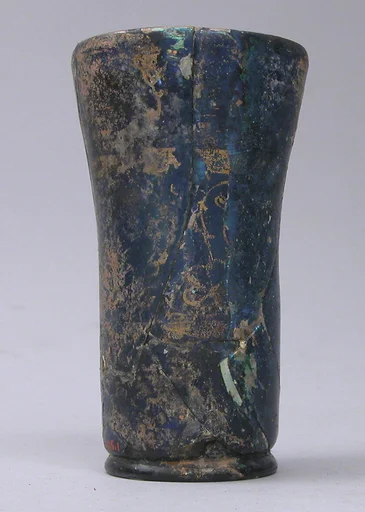
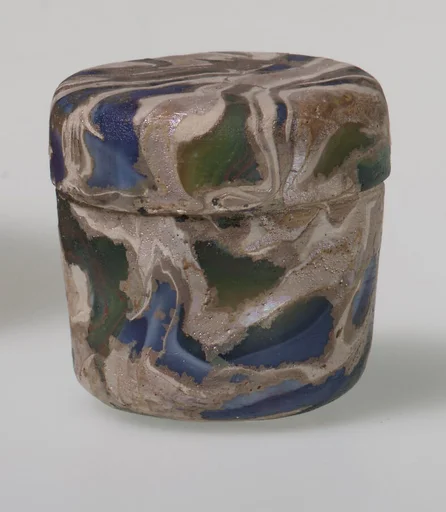
Translucent deep turquoise blue. Plain, vertical rim; vertical but slightly convex sides, with rounded edge to flat bottom. On exterior, immediately below rim a raised horizontal line flanked by a groove above and below, another raised horizontal line flanked by two grooves at bottom of side; and a broader raised concentric circle flanked by two grooves on bottom . Intact; pinprick bubbles; dulling, deep pitting, and patches of iridescence and creamy brown weathering. Rotary grinding marks on exterior and interior. These cups and bowls represent the class of brightly colored translucent wares that dominated the repertoire of Roman cast glass until they were superseded by vessels made in colorless glass. Unlike mosaic glass, which was made primarily in the Syro-Palestinian region, most translucent monochrome vessels were probably made in Italian workshops and are found mainly in archaeological sites in Italy and the western provinces. However, the popularity of such lightly colored vessels was short-lived, spanning the four decades of the mid-first century between about 30 and 70 A.D. Because of this limited production, the group is noticeably homogeneous, whereas greater variety in shape and palette can be seen in their mosaic counterparts (1972.118.185; 13.198.1-.3). The principal colors for this class of cast glasses are deep amber, green or blue, bright turquoise blue, and a manganese purple. The carinated profile was formed by casting a blank of glass between two molds, followed by lathe polishing and cutting on the interior and exterior to create the desired final shape.
- Artist
- Unknown
- Date
- late 1st century BCE–early 1st century CE
- Medium
- Glass
- Culture
- Roman
- Department
- Greek and Roman Art
- Credit line
- H.O. Havemeyer Collection, Bequest of Mrs. H. O. Havemeyer, 1929