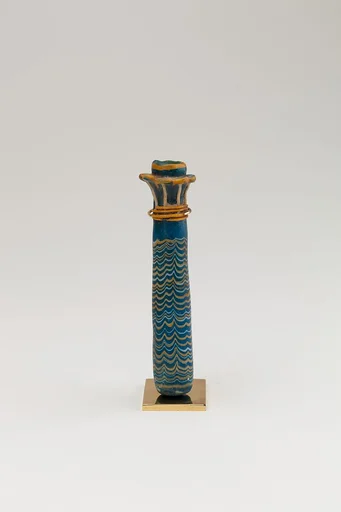
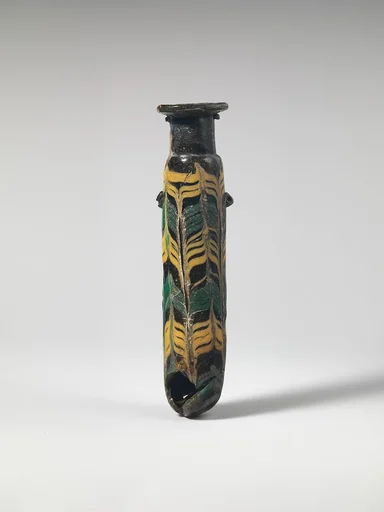
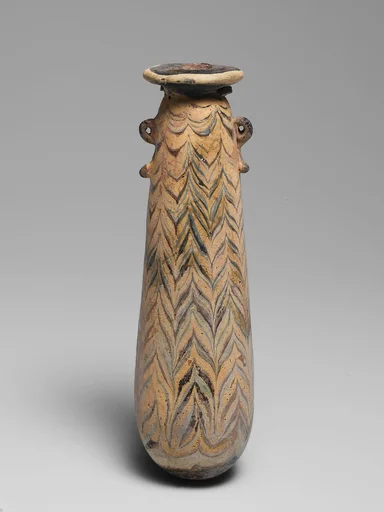
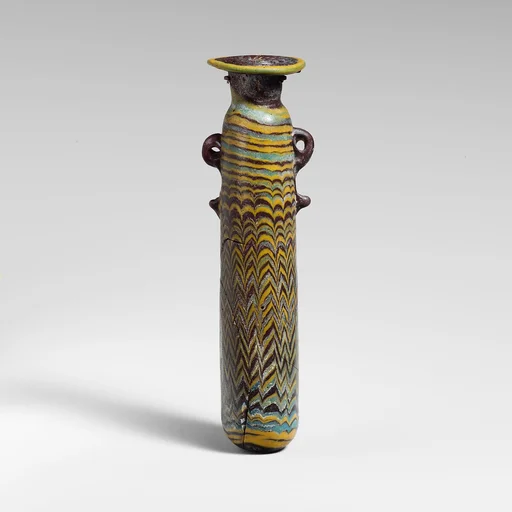
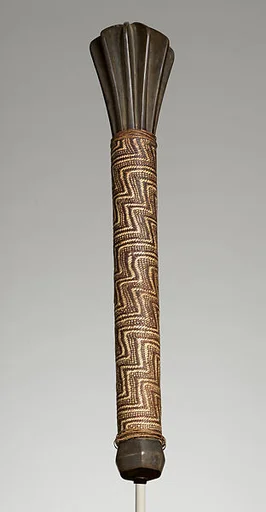
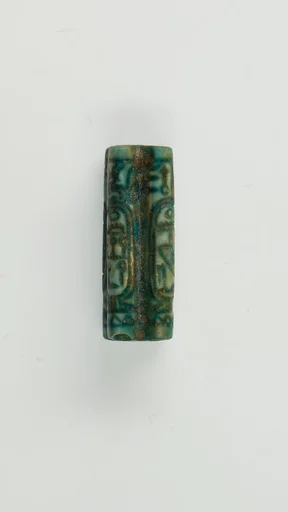
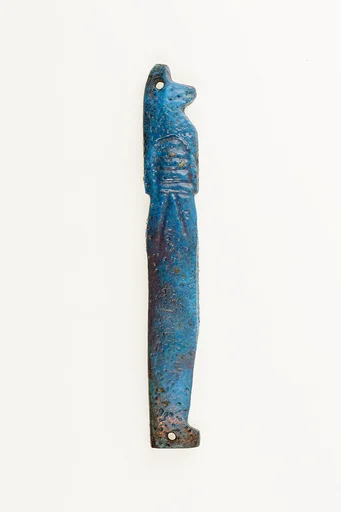
Glass gold-band mosaic alabastron (perfume bottle)
Unknown
1st century BCE · Glass · Greek and Roman Art
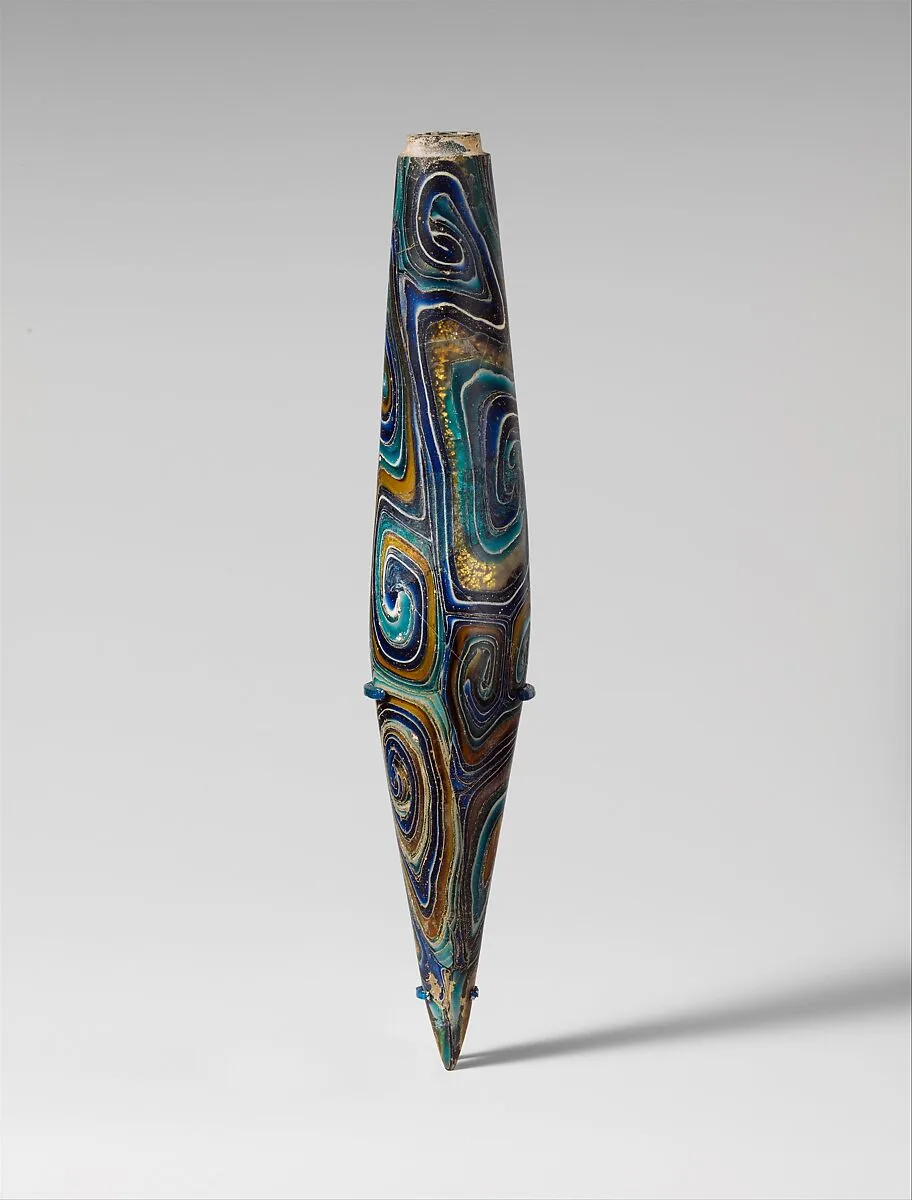
Translucent cobalt blue, colorless, translucent turquoise blue, translucent honey brown, opaque white, and gold leaf. Plain vertical rim, ground flat on top edge; recessed band below to receive neck and rim attachment; biconical body, expanding downwards to midway point, then slanting in to pointed bottom. Gold-band mosaic pattern formed from serpentine lengths of two different canes in combinations of blue and turquoise outlined in white, with one having a band in brown backed with white, the other having a band in colorless encasing shattered gold leaf. The gold-band canes are repeated twice over the body. Broken and repaired, with areas on fill around upper half of body; slight dulling, pitting of surface bubbles, faint iridescent weathering on body, and thick creamy weathering on rim, recessed band, and interior. This is an unusually large gold-band alabastron with a rare pointed shape. Attached to the top was a detachable neck piece or stopper that is now lost. The neck piece had a broad, flat rim and was usually made in a different monochrome glass. A complete example can be seen in the Hellenistic Treasury.
- Artist
- Unknown
- Date
- 1st century BCE
- Medium
- Glass
- Culture
- Greek, Eastern Mediterranean
- Department
- Greek and Roman Art
- Credit line
- Gift of J. Pierpont Morgan, 1917