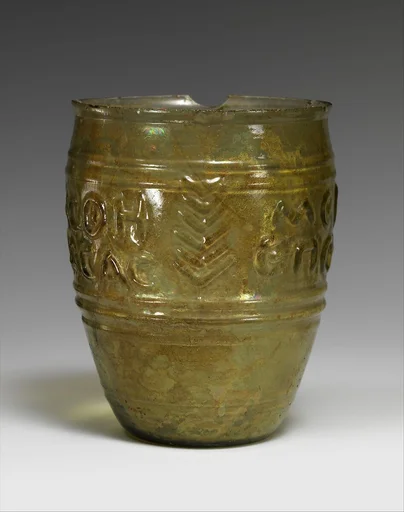
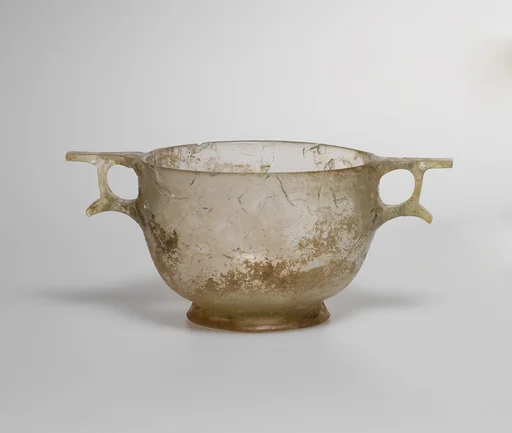
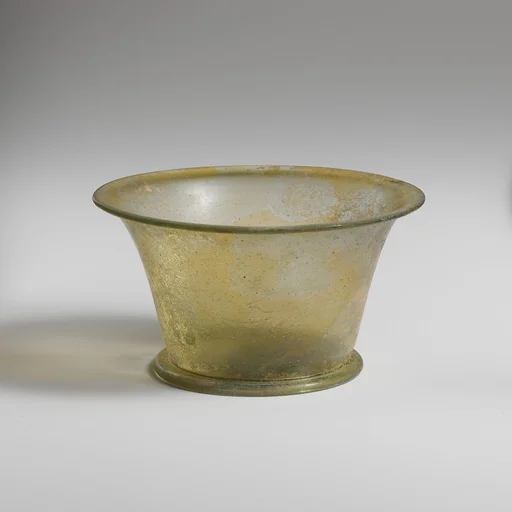
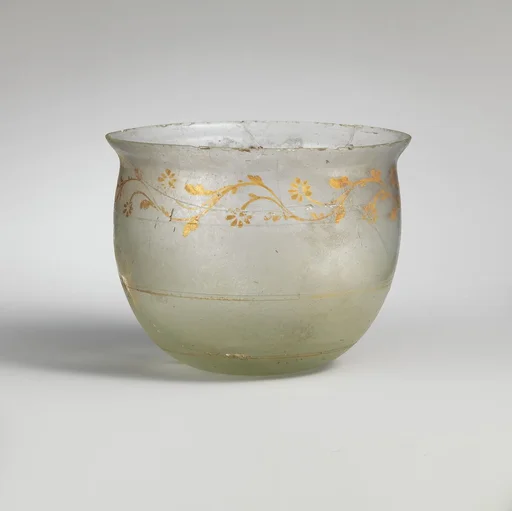
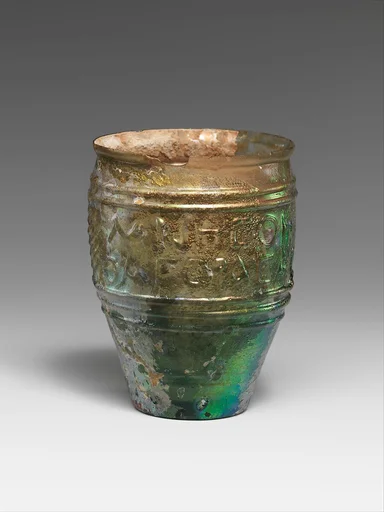
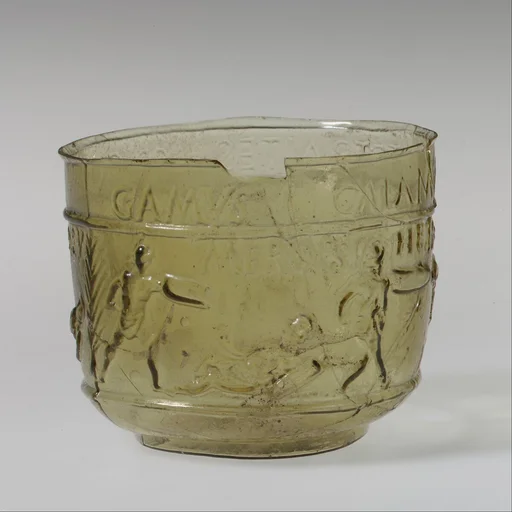
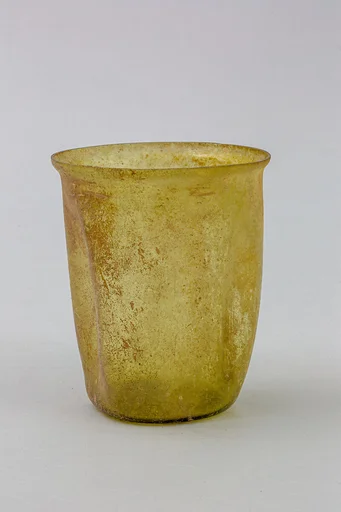
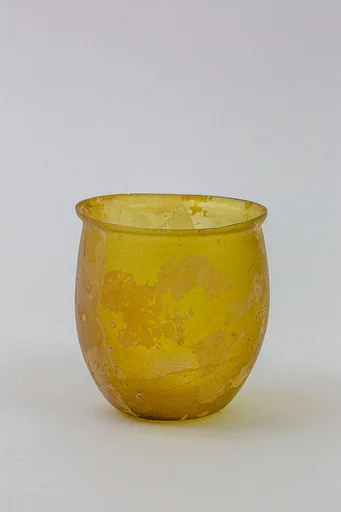
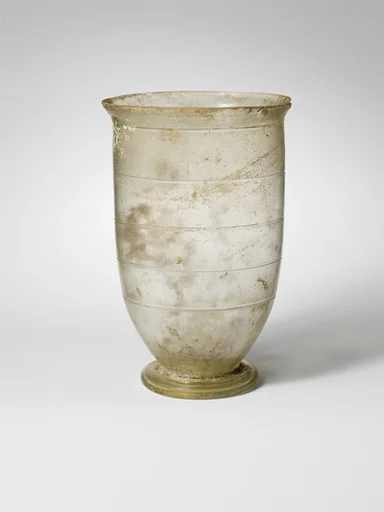
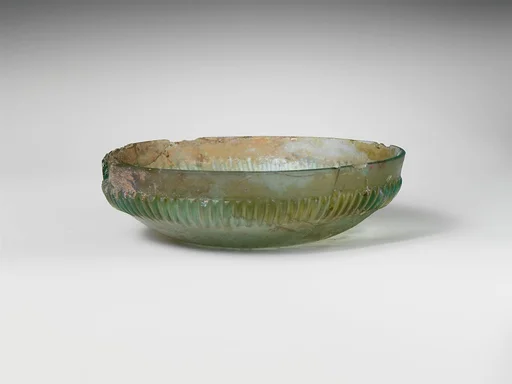
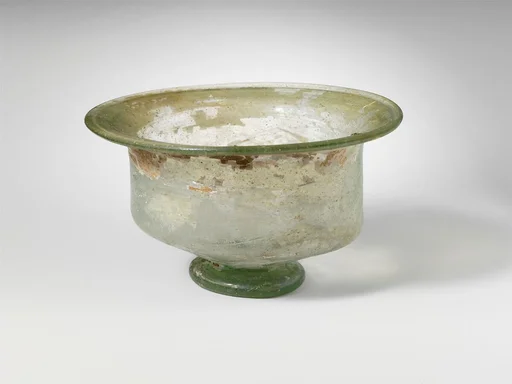
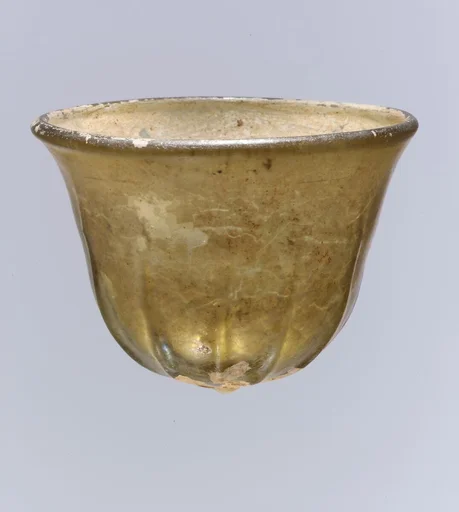
Glass cup
Unknown
1st half of 1st century CE · Glass · Greek and Roman Art
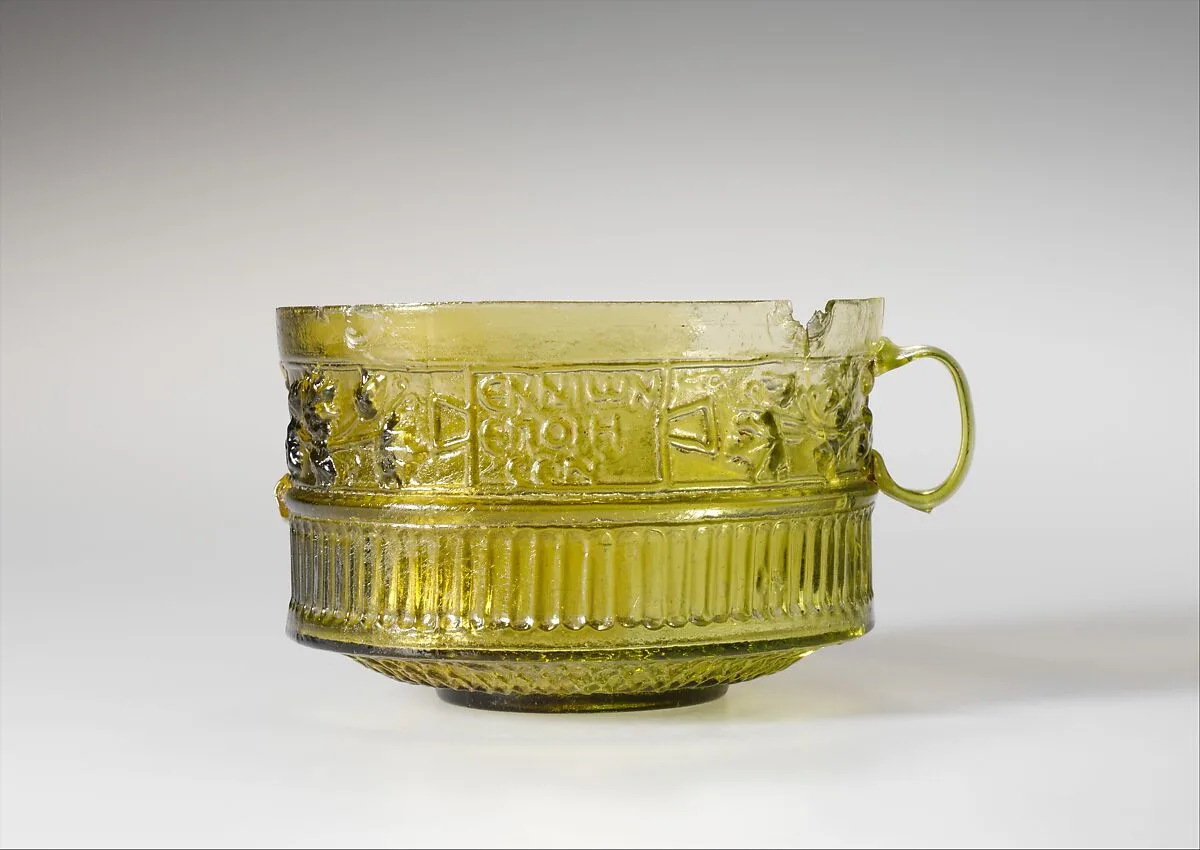
Translucent yellow green with same color handles. Unworked vertical rim of varying thickness; cylindrical body with vertical sides; bottom with S-shaped curve around outer section, then a projecting circular base with raised outer band but concave with slight kick in center; two loop handles attached to sides over upper decorative frieze. Body decorated with a plain band below rim above two horizontal friezes in relief; on the upper, which is bounded above and below by a fine raised line, two Greek inscriptions, each within a tabula ansata; one flanked by ivy sprays with leaves and berries and the other by vine sprays with leaves and bunches of grapes; both sets of foliage issuing from two vertically fluted colonettes with base and Ionic capital, set at sides near handles; dividing the upper from the lower frieze, a broad projecting horizontal ridge; on the lower frieze, close-set vertical flutes, rounded at both ends; on outer section of bottom, a diagonal net pattern; three raised concentric circles and central dot on base. Broken and cracked, with one handle missing and large gap and two smaller chips in rim; a few pinprick bubbles; faint weathering and iridescence. Sides blown in a three-part mold, with mold marks extending to ridge below vertical flutes; separate saucer-shaped mold for underside and bottom. Mold-blowing developed in the early decades of the first century A.D. as an offshoot of free-blowing. The earliest makers of mold-blown glass probably came from the Syro-Palestinian region, although their wares quickly became popular throughout the Roman Empire. The most famous and attractive vessels are signed in Greek by Ennion; about thirty examples of his work survive today. These three vessels show the variety of forms and fine decorated details that Ennion's workshop produced.
- Artist
- Unknown
- Date
- 1st half of 1st century CE
- Medium
- Glass
- Culture
- Roman
- Department
- Greek and Roman Art
- Credit line
- Gift of J. Pierpont Morgan, 1917