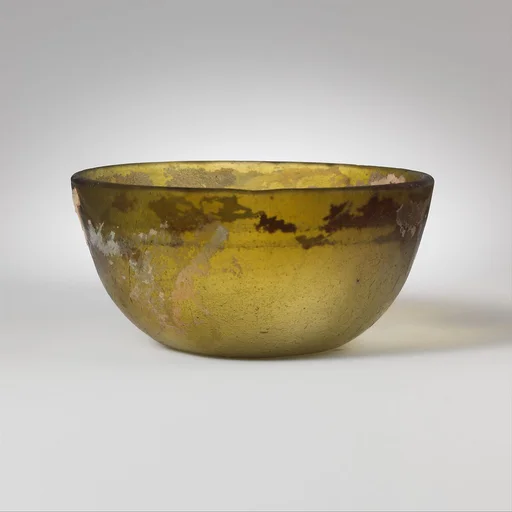
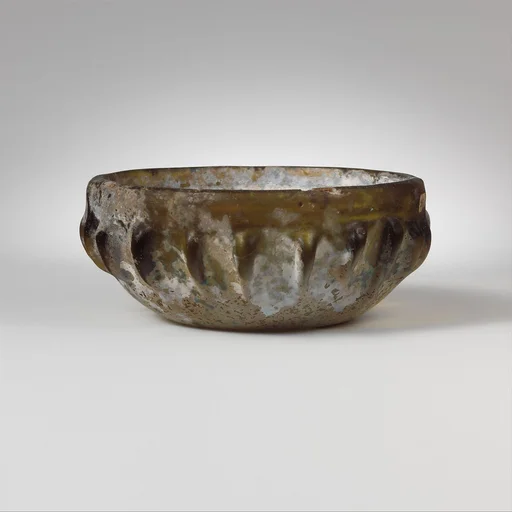
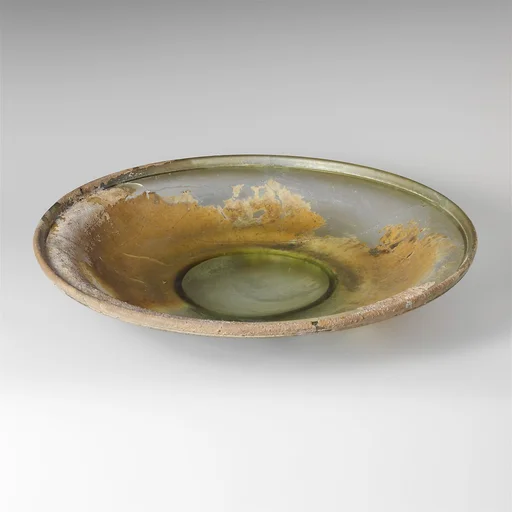
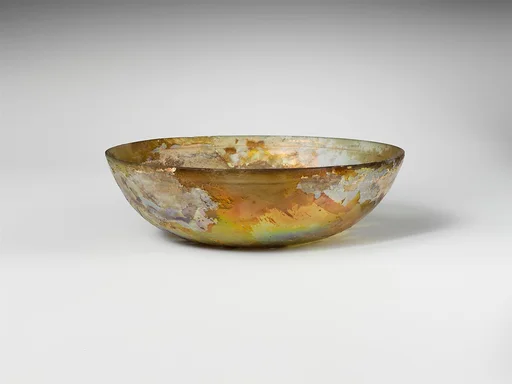
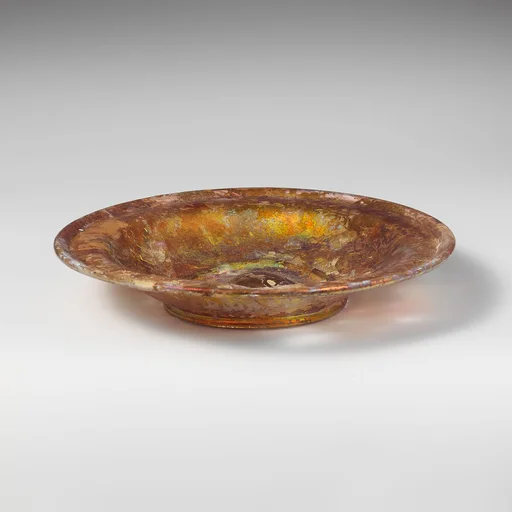
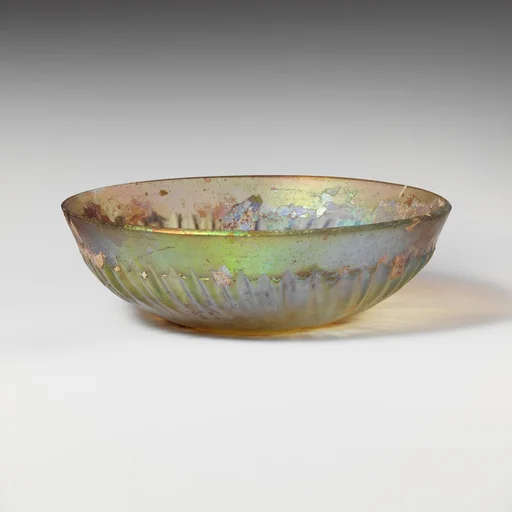
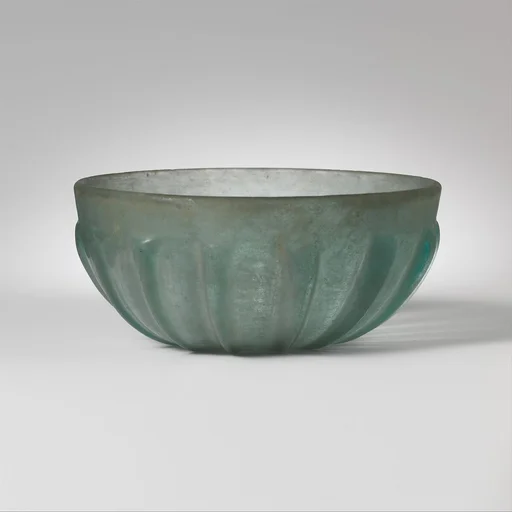
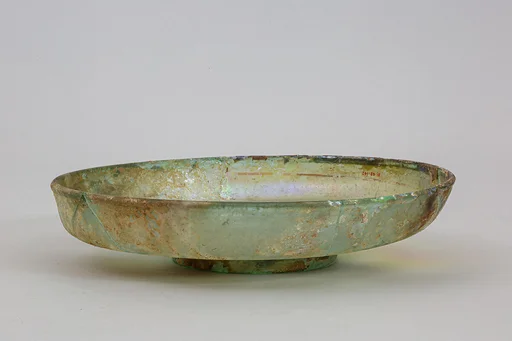
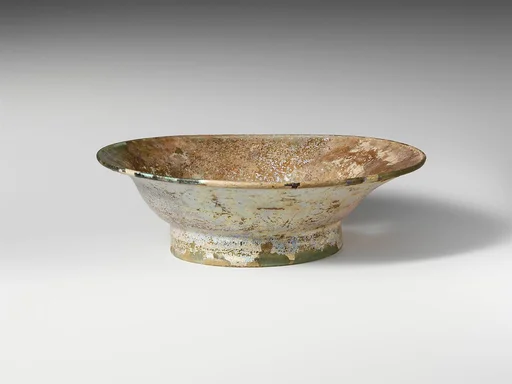
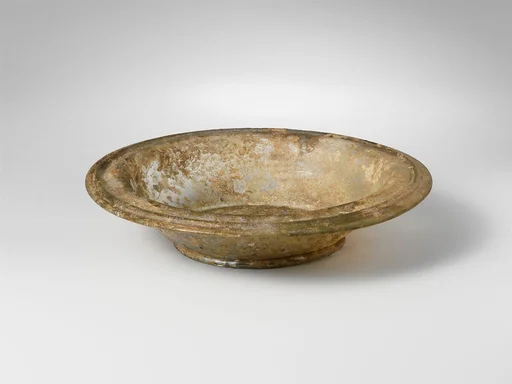
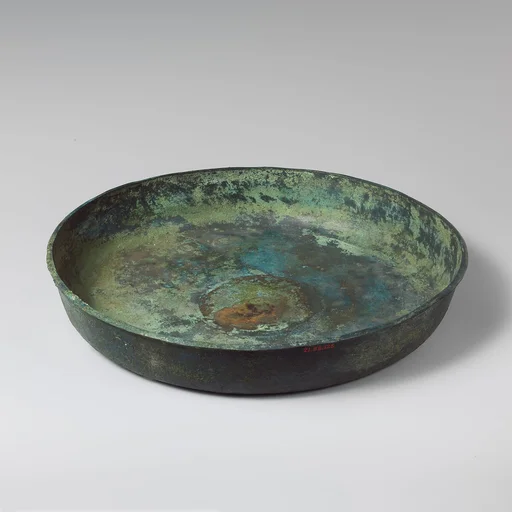
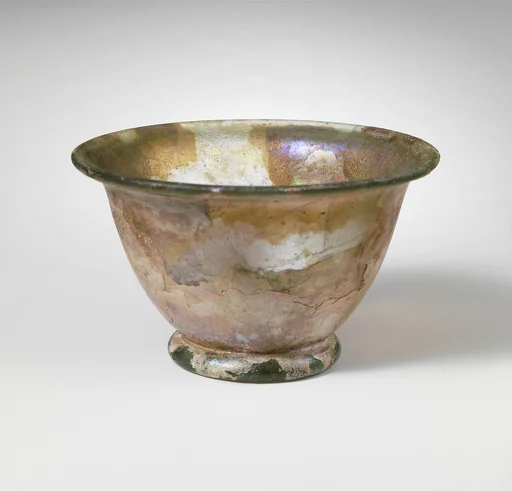
Glass bowl
Unknown
4th century CE · Glass · Greek and Roman Art
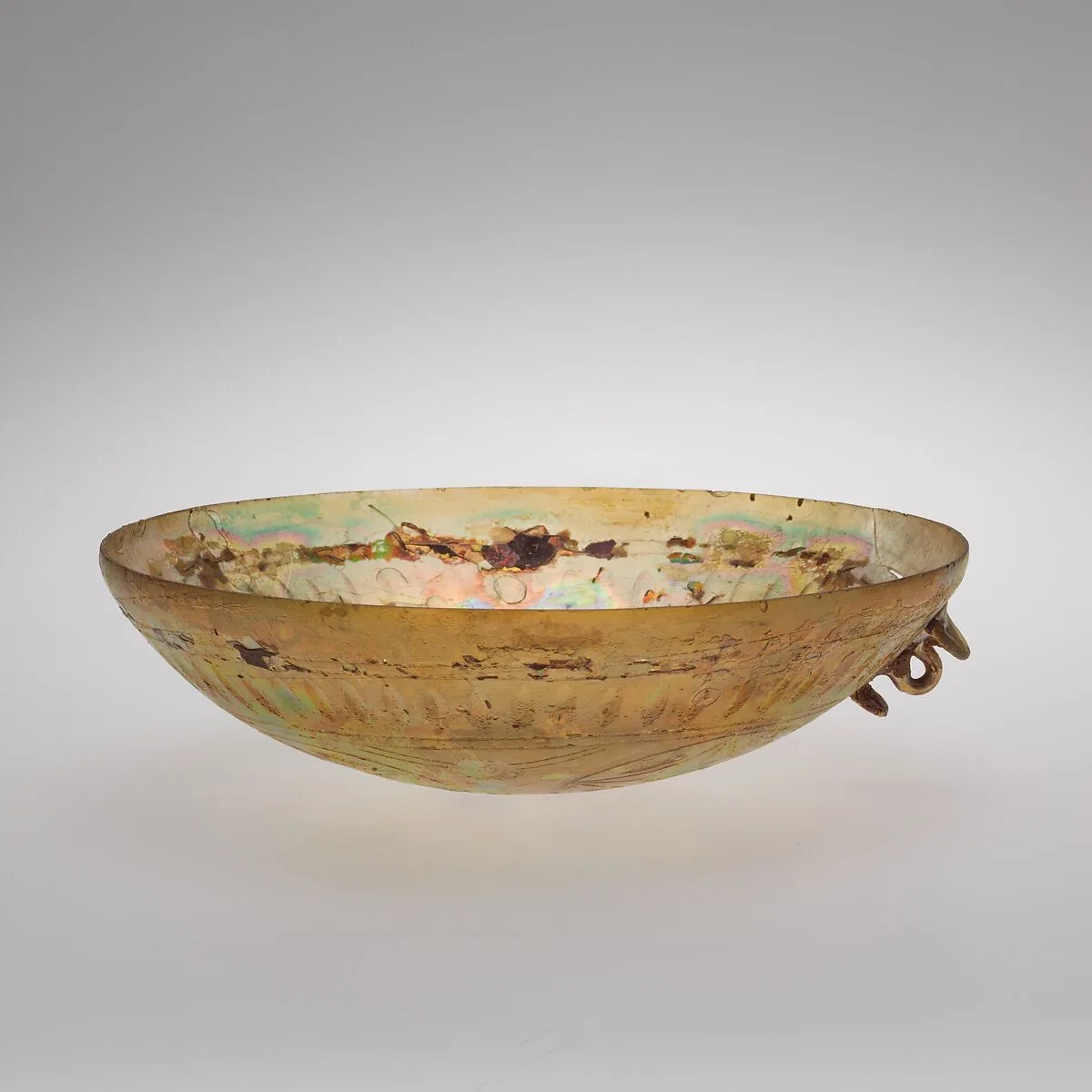
Translucent pale green; handle in same color. Vertical, knocked-off rim; shallow curving body and bottom; small loop handle applied to side before cut decoration, flanked above and below with projecting flanges, tooled flat. Cut decoration comprising on upper side, two concentric grooves below rim above a row of vertical elongated oval facets, flanked below by two more concentric grooves, all interrupted by handle on one side; on lower side and bottom, a circle divided into quadrants by cross of double lines, flanked at center by four elongated oval facets forming an open square, each arm of which ends in a splayed V shape (one enclosing bottom of handle) with circular facet at join, and in each quadrant an oval containing a lozenge-shaped star with cross arms and large central circular facet, and an elongated oval facet between circle and each side of star. One large chip in rim, broken and repaired, but otherwise complete; pinprick bubbles; deep pitting and weathering, with brilliant iridescence. Bowls with similar geometric decoration, miniature handles, and even Greek inscriptions are known to be from the Rhineland. However, both of these examples are probably from the eastern half of the Empire. The purple bowl, which has lost most of its handle, has an engraved inscription in Greek, PIE ZESAIS (Drink [so that] you may live [well]). The same exhortation, but with a slightly different spelling, appears on another goblet (13.198.5) on view in this case. [Group label with 17.120.249]
- Artist
- Unknown
- Date
- 4th century CE
- Medium
- Glass
- Culture
- Roman
- Department
- Greek and Roman Art
- Credit line
- Bequest of Isaac D. Fletcher, 1917