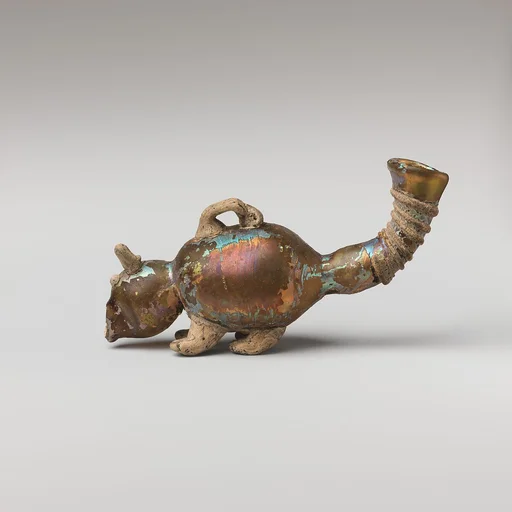
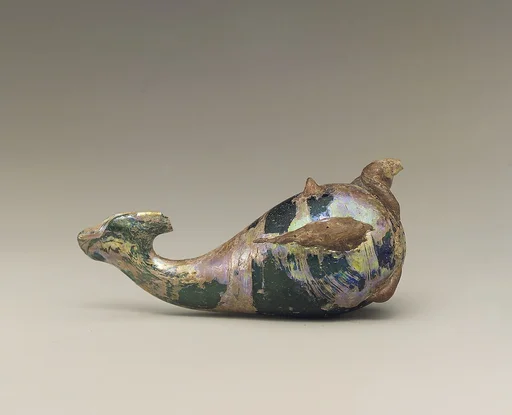
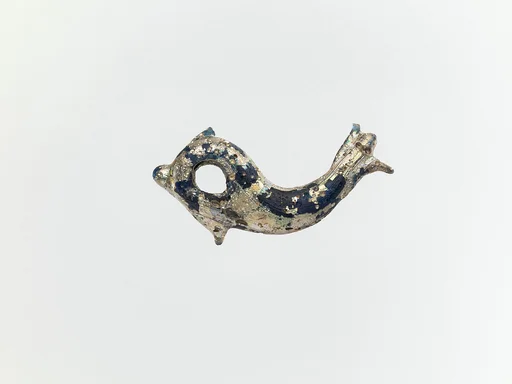
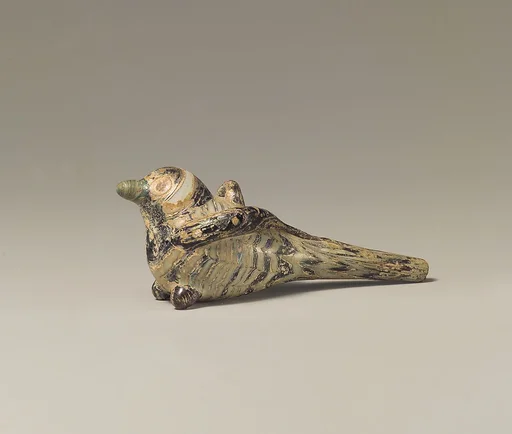
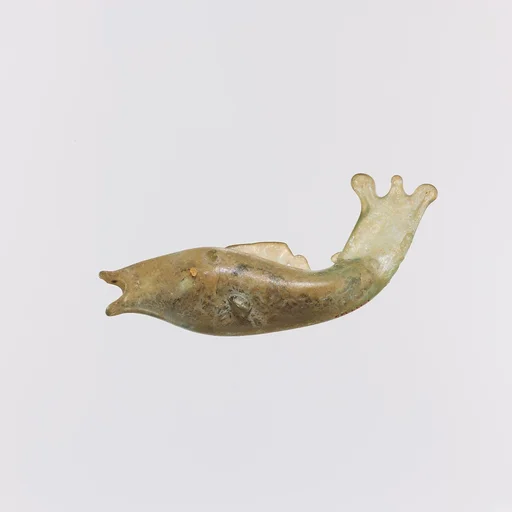
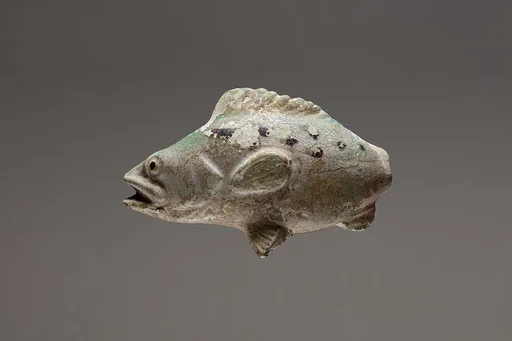
Glass flask in the form of a fish
Unknown
3rd century CE · Glass · Greek and Roman Art
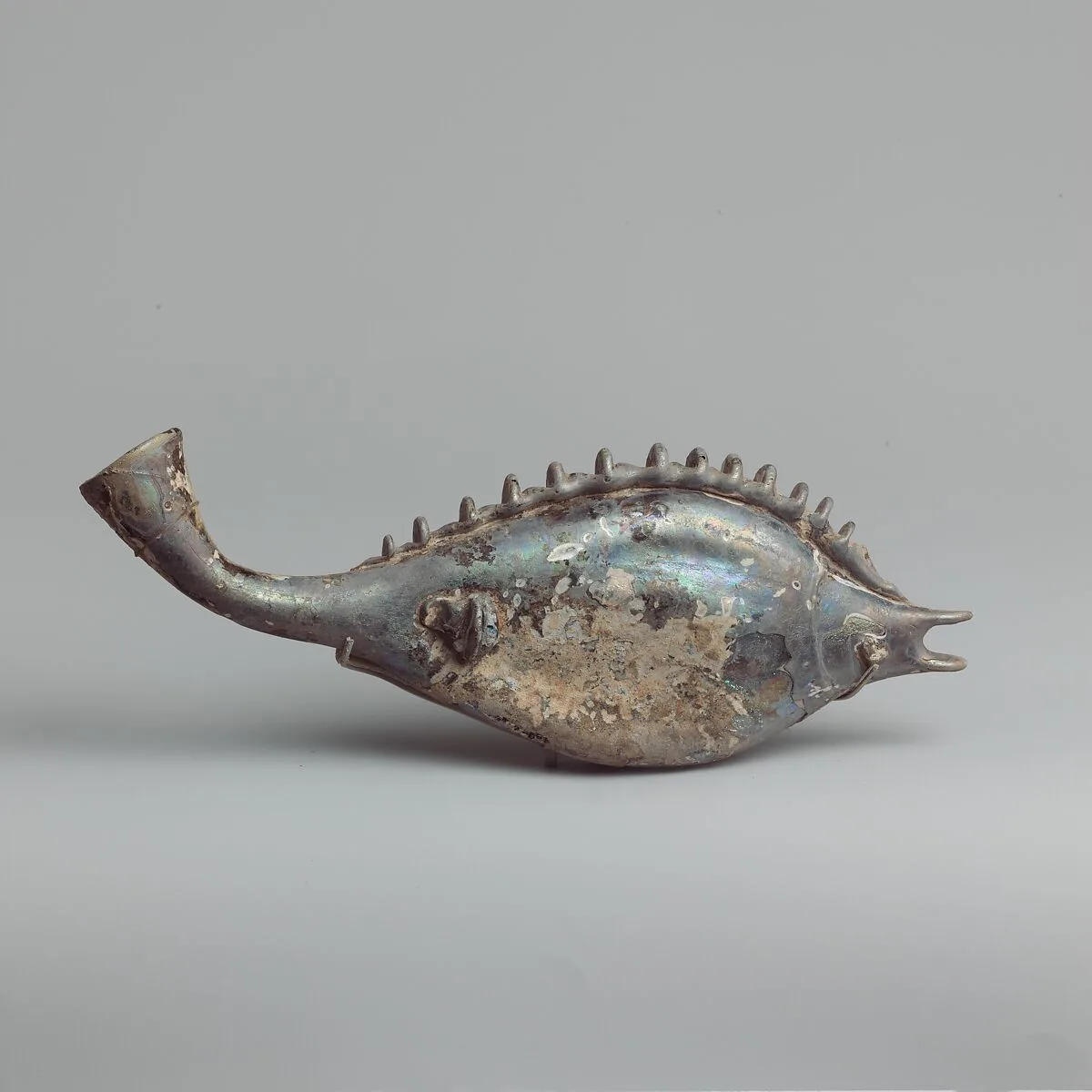
Uncertain color (probably colorless); trails in same glass. Rounded, thickened rim; neck bent upward to form tail, tapering towards body; body flattened into irregular lentoid shape; bottom drawn out in two solid projections to form mouth. Fine trail wound once round neck; another trail wound once around lower body to form gills; between gills and mouth, two applied blobs for eyes, one on each side of body; long thick trail applied to upper edge of body from behind mouth to base of neck, pinched into thirteen flat, projecting flanges, for dorsal fin; and two large blobs, tooled into vertical, flat flanges, applied to top of body as rear fins (these are anatomically incorrect). Intact; pinprick bubbles; severe pitting and weathering, with most of surfaces covered in a grey, enamel-like weathering layer and some patches of brilliant iridescence. Glass containers in the form of a fish were probably made in the Syro-Palestinian region. Whether their shape relates specifically to their contents (that is, a sauce to pour on a fish dish) or is merely a decorative whim cannot now be determined. It is unlikely, however, that they had any specifically Christian symbolic associations.
- Artist
- Unknown
- Date
- 3rd century CE
- Medium
- Glass
- Culture
- Roman
- Department
- Greek and Roman Art
- Credit line
- Bequest of Mary Anna Palmer Draper, 1915