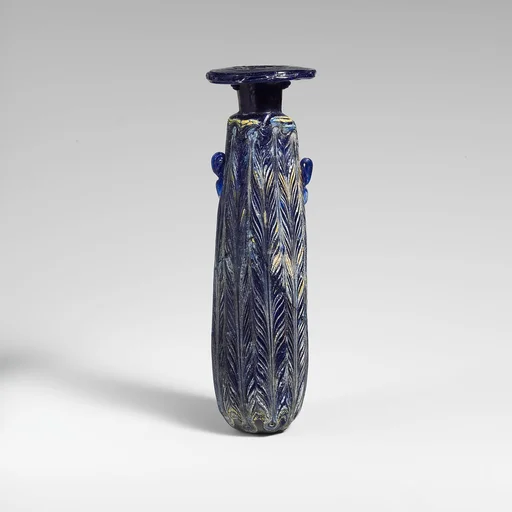
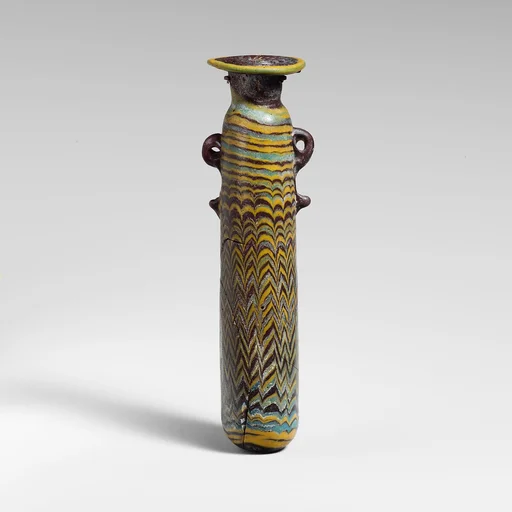
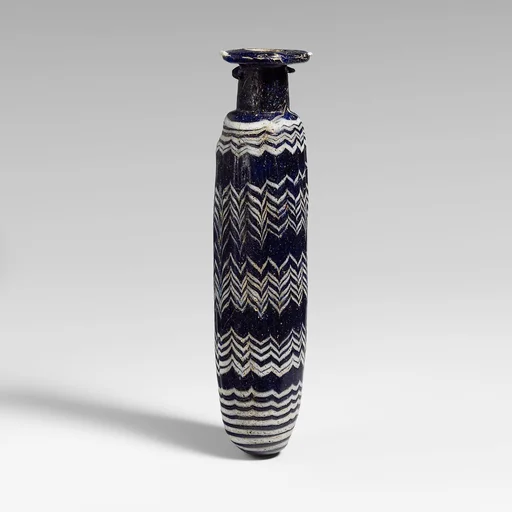
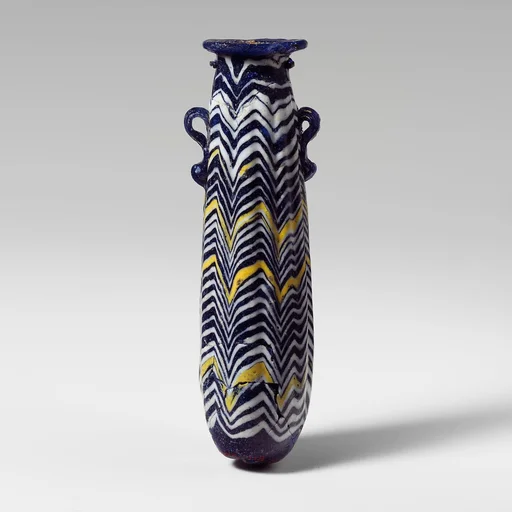
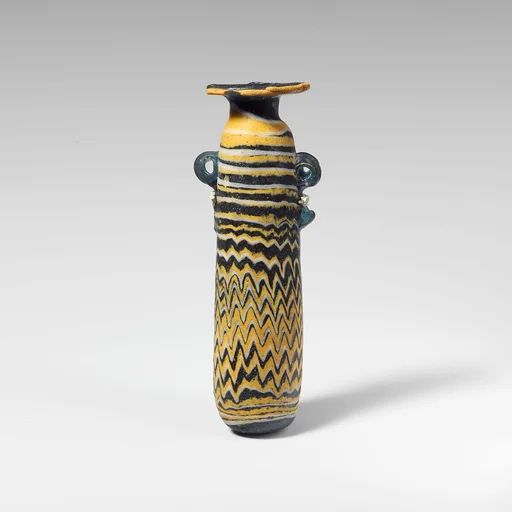
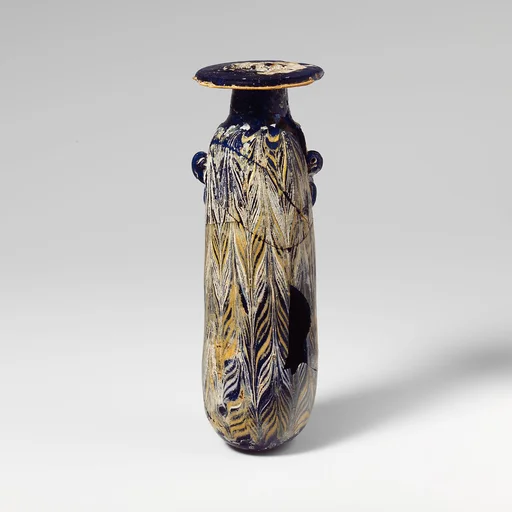
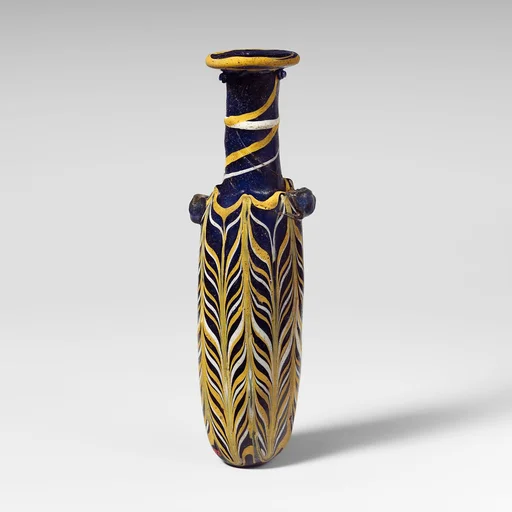
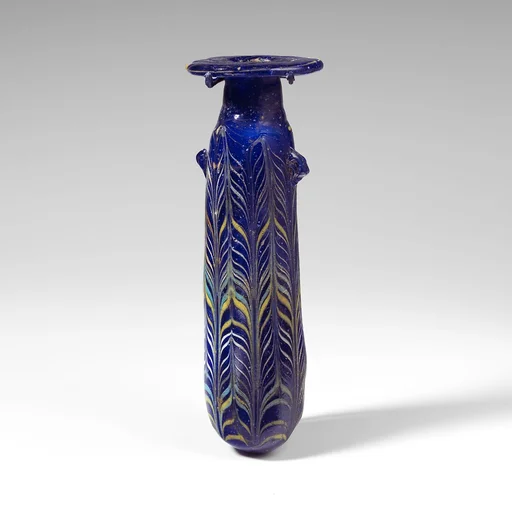
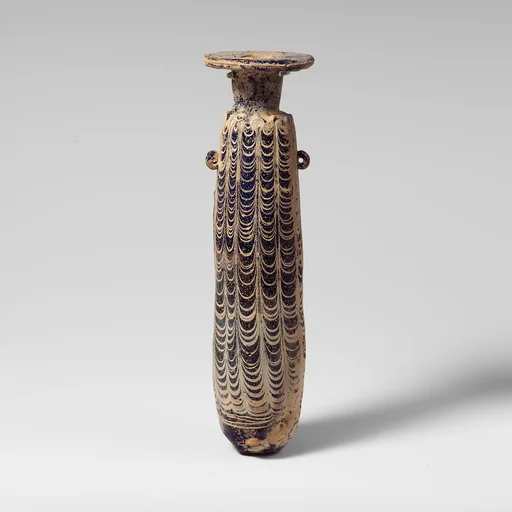
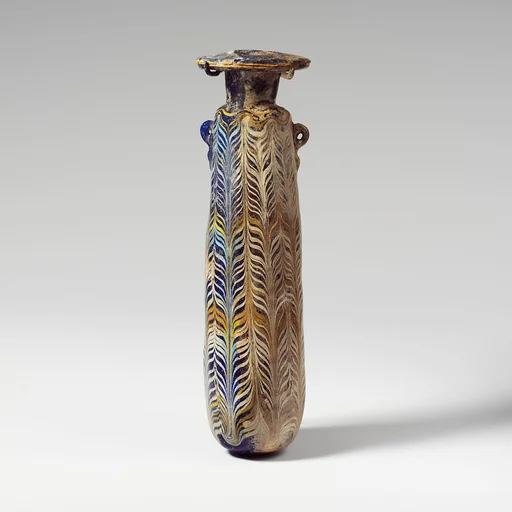
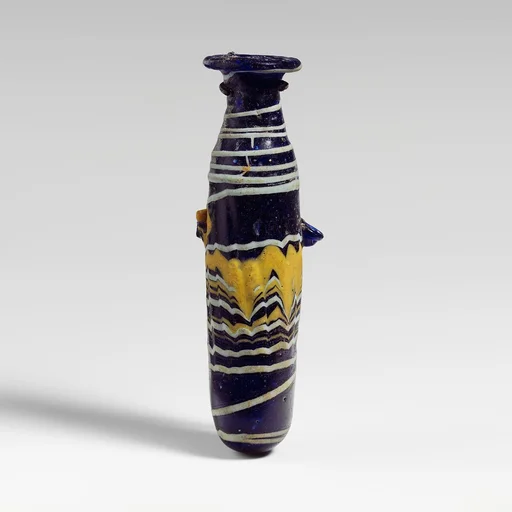
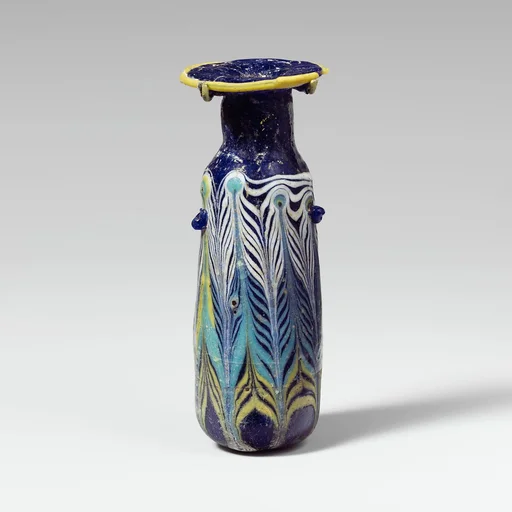
Glass alabastron (perfume bottle)
Unknown
late 4th–early 3rd century BCE · Glass · Greek and Roman Art
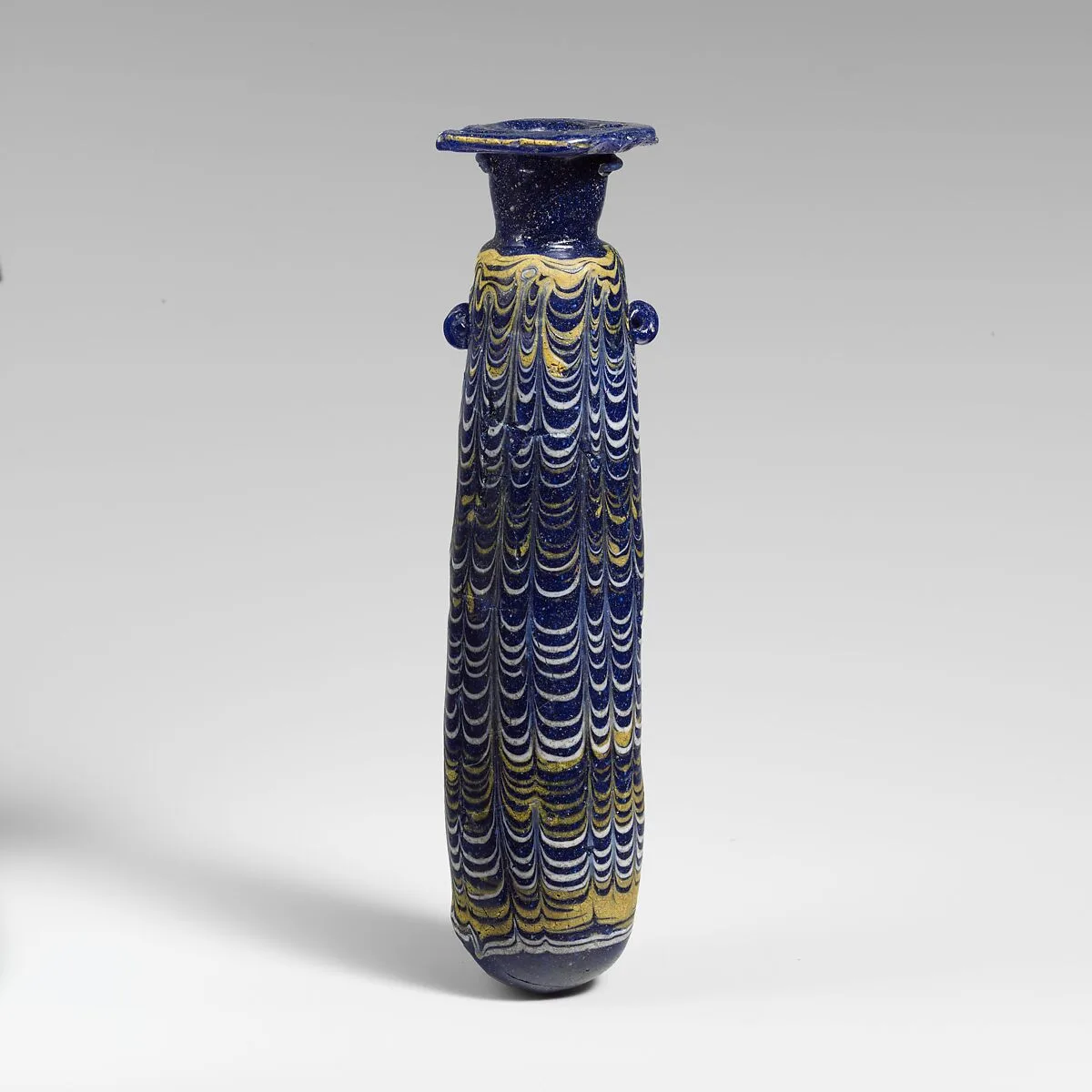
Translucent cobalt blue, with handles in same color; trails in opaque yellow and opaque white. Broad slightly uneven rim-disk, made as a spiral coil around top of neck; cylindrical neck, tapering downwards; angular shoulder; straight-sided cylindrical body, with slight upward taper; convex bottom; on upper body, two vertical ring handles, applied over trail pattern, one slightly higher than the other. A yellow trail attached at edge of rim-disk; on body, alternating bands of yellow and white, tooled from top of body to undercurve at bottom into a widely spaced festoon pattern in nine vertical panels with fourteen upward strokes, forming round loops at top. Broken and repaired, with about one third of rim-disk missing, and small holes and chips in body; many white inclusions; some trails completely weathered, leaving hollow lines in body; slight dulling, faint iridescent weathering, and some deep pitting. Among the more striking examples of glass perfume vessels of the fourth century B.C. are tall, large-bodied alabastra in dark grounds with applied threads combed into zigzag, feather, or festoon patterns over the body.
- Artist
- Unknown
- Date
- late 4th–early 3rd century BCE
- Medium
- Glass
- Culture
- Eastern Mediterranean or Italian
- Department
- Greek and Roman Art
- Credit line
- Gift of Henry G. Marquand, 1881