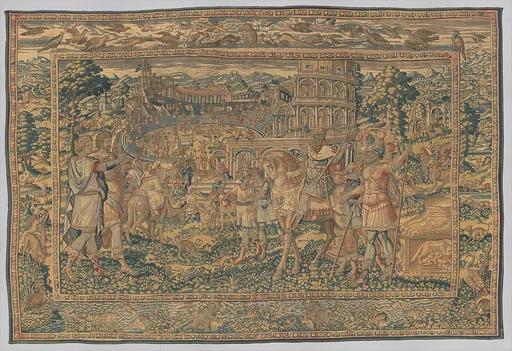
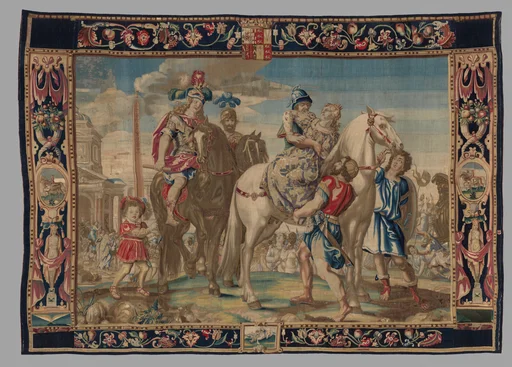
Agamemnon musters the Greek troops at Aulis from the “Story of Iphigenia”
Pieter Coecke van Aelst|Willem de Kempeneer
1535–48 · Wool, silk (16-17 warps per inch, 6-7 per cm.) · European Sculpture and Decorative Arts
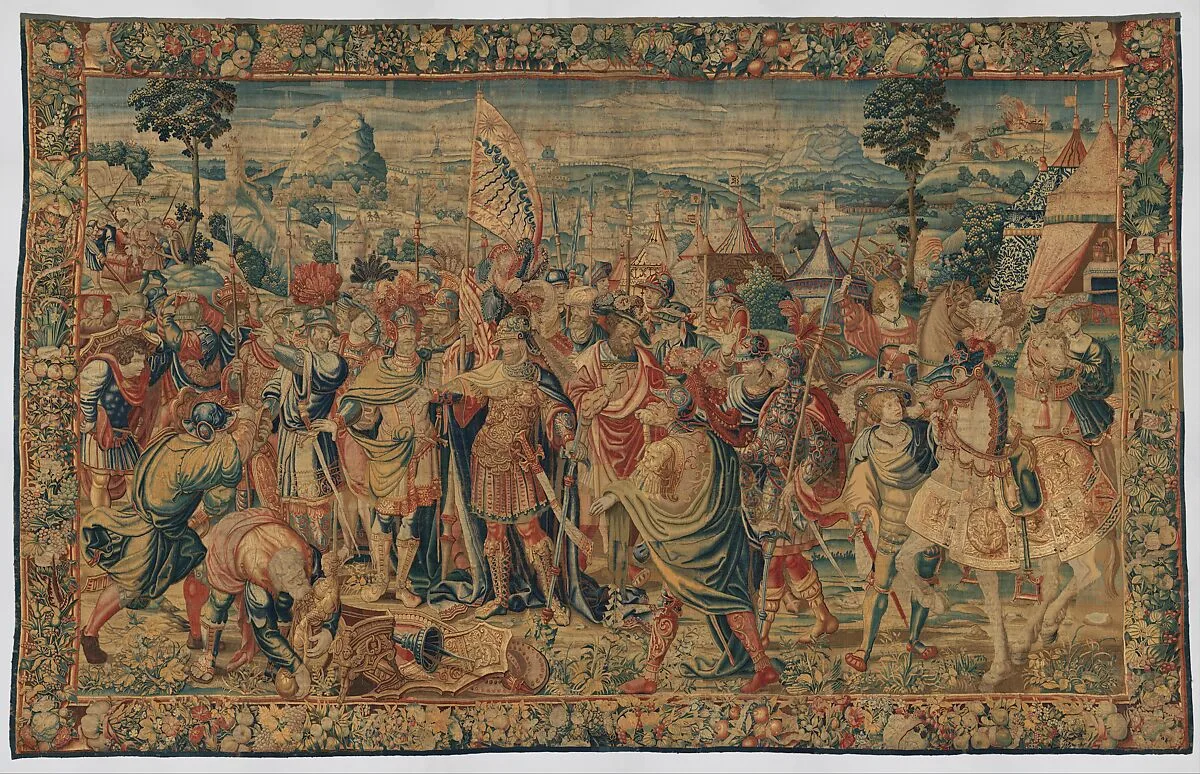
A martial commander, richly clad in armor, stands amidst a bustling military encampment, perhaps preparing for departure, with shields, lances, chests and other rich objects piled in front of him. Despite the seeming cohesion of this composition, the design was apparently assembled from a group of existing figure patterns, recognizable from other successful narrative tapestry series designed by artists in the circle of Bernard van Orley and by Pieter Coecke van Aelst. In this instance, the narrative might be that of Iphigenia, the ill-fated daughter of Agamemnon and Clytemnestra, who was sacrificed by her father to appease the goddess Artemis and petition her to enable sailing weather for the Greek fleet waiting to embark from Aulis and invade Troy. It is possible that this tapestry was part of a different edition of the same Story of Iphigenia series, also woven in the workshop of admired, Brussels-based weaver Willem de Kempeneer, inventoried in the collection of François 1er, King of France, in the 1550s (his edition included precious metal-wrapped threads). The tapestry was previously identified in the literature as a Scene from the Old Testament on the grounds of its notable similarity to the Story of David and Bathsheba in the Musée National de la Renaissance, Ecouen.
- Artist
- Pieter Coecke van Aelst|Willem de Kempeneer
- Date
- 1535–48
- Medium
- Wool, silk (16-17 warps per inch, 6-7 per cm.)
- Culture
- Netherlandish, Brussels
- Department
- European Sculpture and Decorative Arts
- Credit line
- Gift of Mrs. Constance McCann Betts, Mrs. Winston F.C. Guest, and Frasier W. McCann, 1942