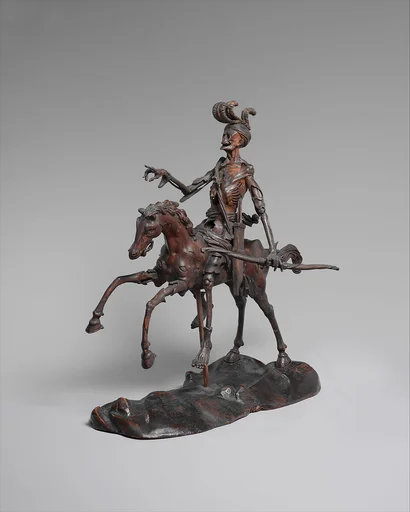
Mounted Hussar
Ernest Meissonier
1866–75 · Red wax, wood, metal, leather and cord · European Sculpture and Decorative Arts
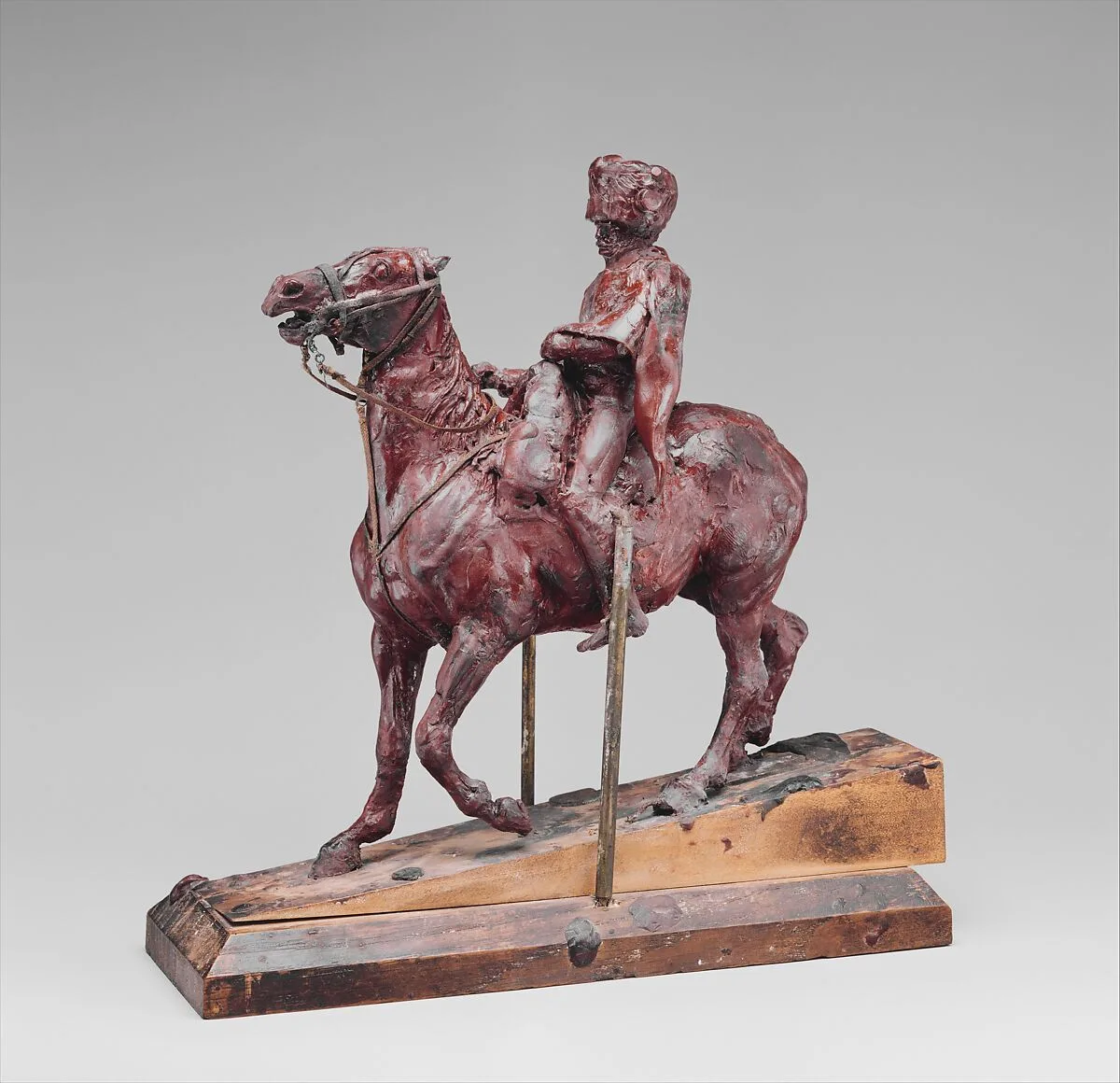
Meissonier's Friedland, 1807 (acc. no. 87.20.11), a broad canvas celebrating a Napoleonic victory as envisioned by a firm adherent of the Second Empire, is arguably the most important academic painting of the second half of the nineteenth century in the Museum's collection. Begun in the mid-1850s, it was completed only in 1875. One reason for the long delay was Meissonier's extraordinary preparatory research. The work was preceded by many drawings, oil sketches, and, for the primary horsemen, several wax models, of which this may be the only one to survive. The medium is perishable by nature. A wire armature was affixed to a small piece of wood, and warm pellets of wax were pressed onto it to form the figures. In a photo of Meissonier's atelier, this very model is clamped to his modeling stand. He could thus view it from any angle and sketch from it. That our hussar and his mount appear to the left and more frontally positioned in Meissonier's grandly orchestrated chef d'oeuvre contributes to the overall photo- graphic semblance of frozen movement
- Artist
- Ernest Meissonier
- Date
- 1866–75
- Medium
- Red wax, wood, metal, leather and cord
- Culture
- French
- Department
- European Sculpture and Decorative Arts
- Credit line
- Purchase, Iris and B. Gerald Cantor Foundation Gift, in celebration of its 25th Anniversary, 2002