The Mass of St. Gregory
Unknown
1550–60 · Wood, polychromed, gilt and silvered · European Sculpture and Decorative Arts
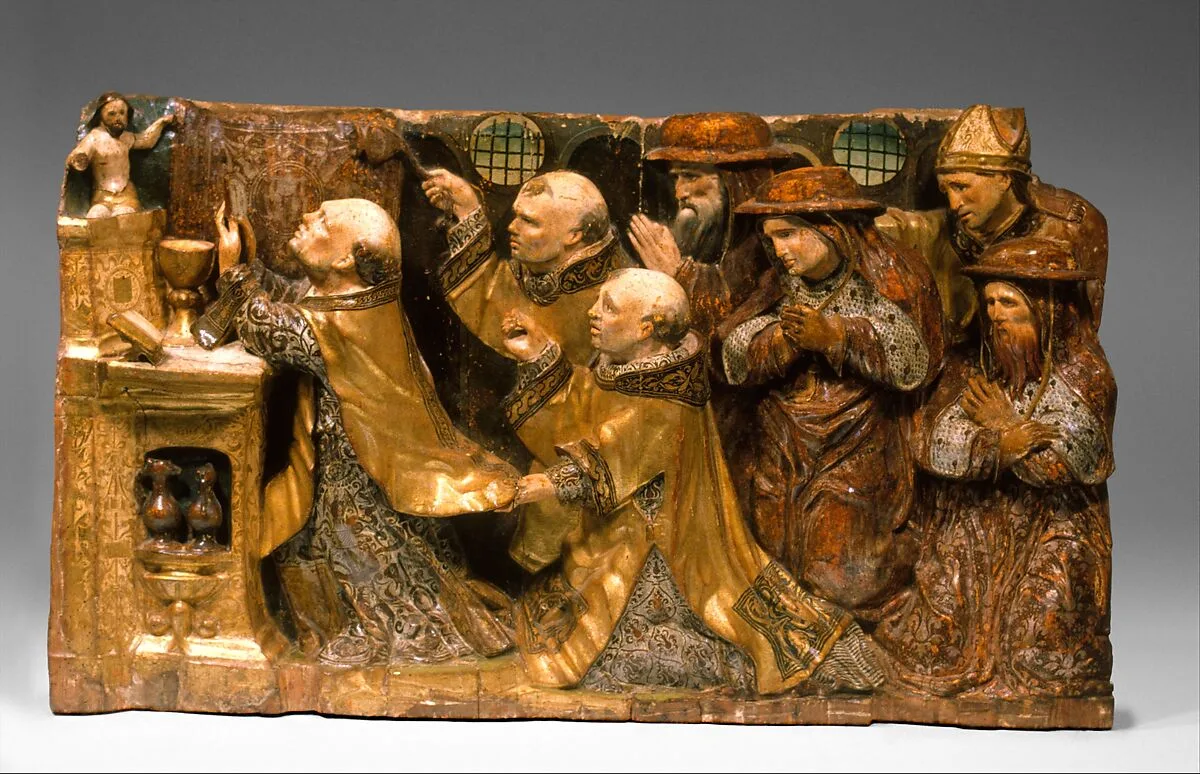
Late medieval imagists formulated a vision popularly ascribed to Gregory the Great, in which Christ as the Man of Sorrows appears on the altar and shows his wounds to the pontiff as he elevates the host during Mass. The theme, often invoked to demonstrate the truth of substantiation, was later discredited and virtually disappeared by the seventeenth century. The format and leftward movement of this relief suggest that it came from the right-hand predella of a multipaneled retablo, the characteristic form of a Spanish altarpiece. The carving is by an uncommonly gifted member of the Castilian school. Although he was touched by the lessons of the great master sculptors Alonso Berruguete (1488-1561) and Juan de Juni (about 1507–1577), he shows his own flair for narrative and an independent physiognomical manner, as in the broad skulls of the celebrant and assisting clergy. He was also securely grounded in the techniques of estofado, in which paint is applied over gilding and then scratched away to create dramatically contrasting patterns. He employed silvering as well as gilding; the five wounds of Christ on the banner behind Gregory's head are picked out in sgraffito on a silvered ground. The palette has been altered by the application of a shiny varnish, but when this is removed in the course of conservation, the play of gold and silver upon the diagonal arrangement of forms should be dazzling
- Artist
- Unknown
- Date
- 1550–60
- Medium
- Wood, polychromed, gilt and silvered
- Culture
- Spanish, Castilian
- Department
- European Sculpture and Decorative Arts
- Credit line
- Purchase, Gift of J. Pierpont Morgan, by exchange, 1988