Jar
Unknown
ca. 1625–50 · Tin-glazed earthenware · European Sculpture and Decorative Arts
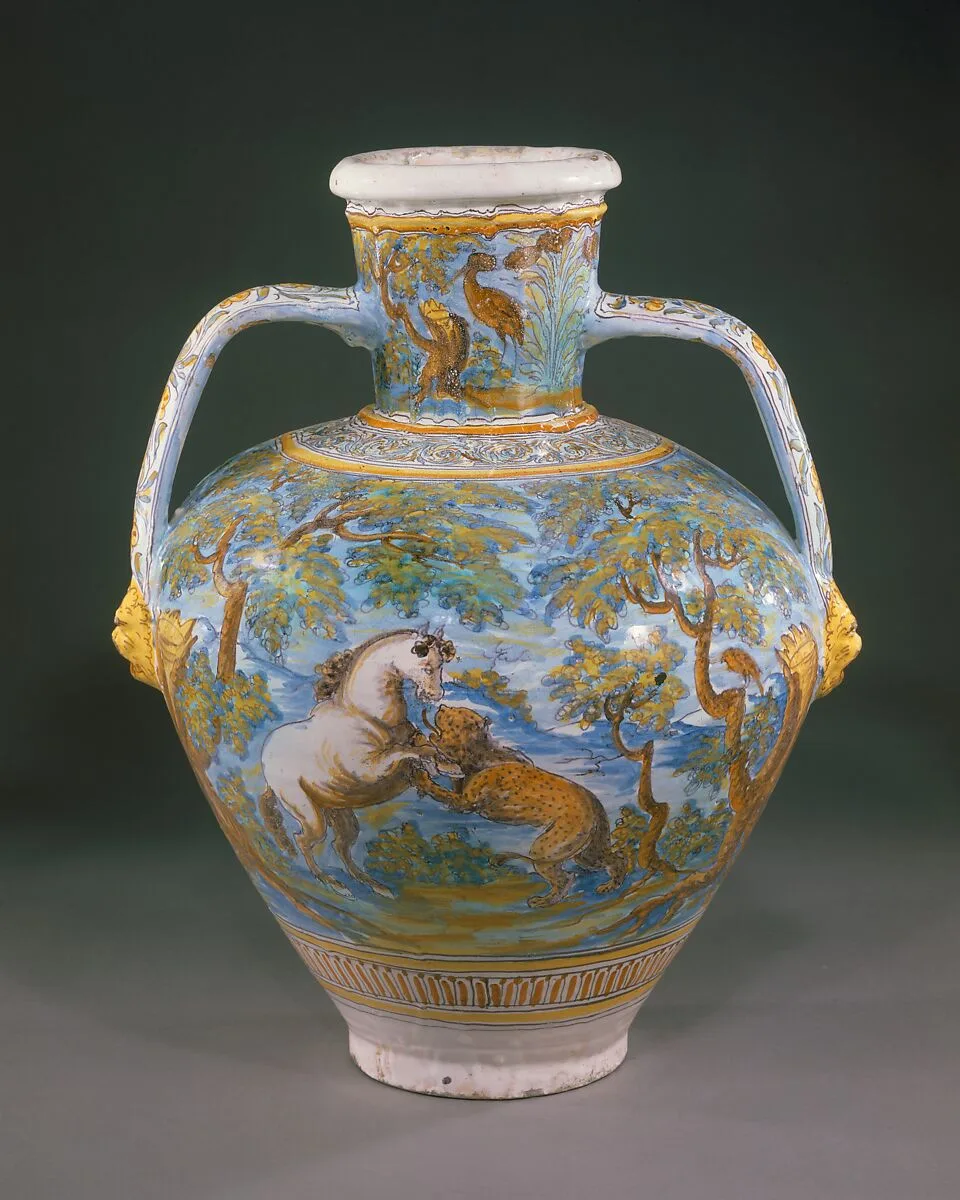
During the course of the sixteenth century a number of potteries making tin-enameled earthenware came into existence in Talavera de la Reina, a small town some sixty miles southwest of Madrid. The town supplied plain wares that were greatly admired for the beauty of their white surface—the "bianco"—and others that were decorated in a subdued palette of high-temperature greens, yellows, browns, blues, and purples. This jar and bowl (1983.469.1, .2) come from a pottery, so far unidentified by name, that seems to have obtained important orders over a fairly long period in the late sixteenth and the seventeenth centuries. The characteristics of the factory are well exemplified in these objects: a fine bianco; a very beautiful blue—skillfully modulated from light to deep shades—that predominated in the early and mid-16oos; and an energetic freedom in the use of the brush point to draw in figures and background vegetation. In the latter part of the seventeenth century the prevailing to
- Artist
- Unknown
- Date
- ca. 1625–50
- Medium
- Tin-glazed earthenware
- Culture
- Spanish, Talavera de la Reina
- Department
- European Sculpture and Decorative Arts
- Credit line
- Purchase, Gift of Irwin Untermyer, by exchange, 1983