Two Landsknechts
Unknown
mid-16th century · Bronze, with natural brown patina, and remains of black lacquer · European Sculpture and Decorative Arts
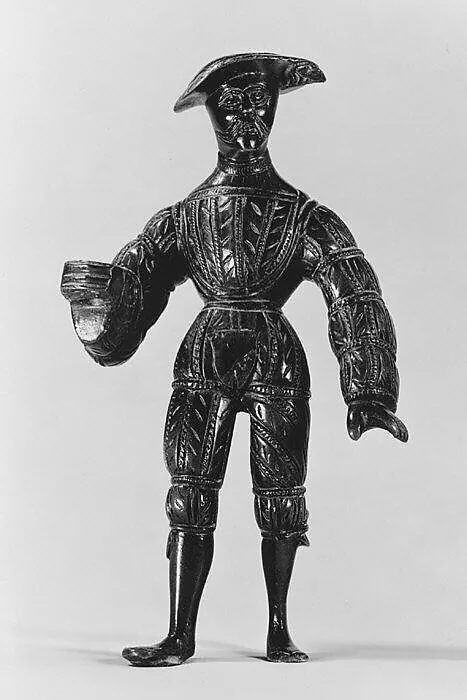
The two landsknechts, varying slightly in height and in costume, originally served as candle holders; candles were inserted in the holes in their raised hands. Bronze projections from the insteps of the taller soldier indicate that the figures belong to a common sixteenth-century type, of brass as well as of bronze, in which the feet often stood on flared stems riding from circular bases.[1] The folkloric designs were popular again in the nineteenth century; a thinly cast copy of one of our landsknechts appears on a candlestick in the reserves of the Louvre, paired with a variant model.[2] [James David Draper, The Jack and Belle Linsky Collection in the Metropolitan Museum of Art, New York, 1984, p. 165, nos. 82, 83] Footnotes: [1] V. Baur, Kerzenleuchter aus Metall, Munich, 1977, pls. 58–61; E. Turner, An Introduction to Brass, London, 1982, pl. 13. [2] G. Migeon, Catalogue des bronzes et cuivres du Moyen Age, de la Renaissance et des temps modernes, Paris, Musée National du Louvre, 1904, no. 119.
- Artist
- Unknown
- Date
- mid-16th century
- Medium
- Bronze, with natural brown patina, and remains of black lacquer
- Culture
- German, probably Nuremberg
- Department
- European Sculpture and Decorative Arts
- Credit line
- The Jack and Belle Linsky Collection, 1982