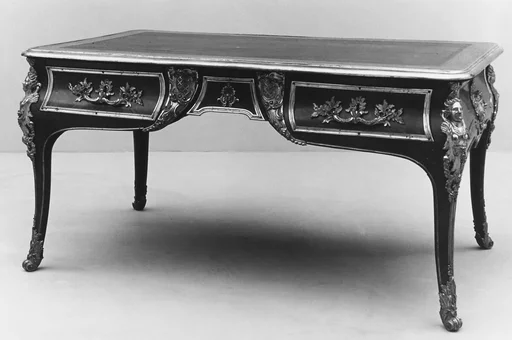
Writing table (bureau plat)
Jean-François Leleu
ca. 1780 · Oak, veneered with mahogany, sycamore and holly; gilt bronze, leather · European Sculpture and Decorative Arts
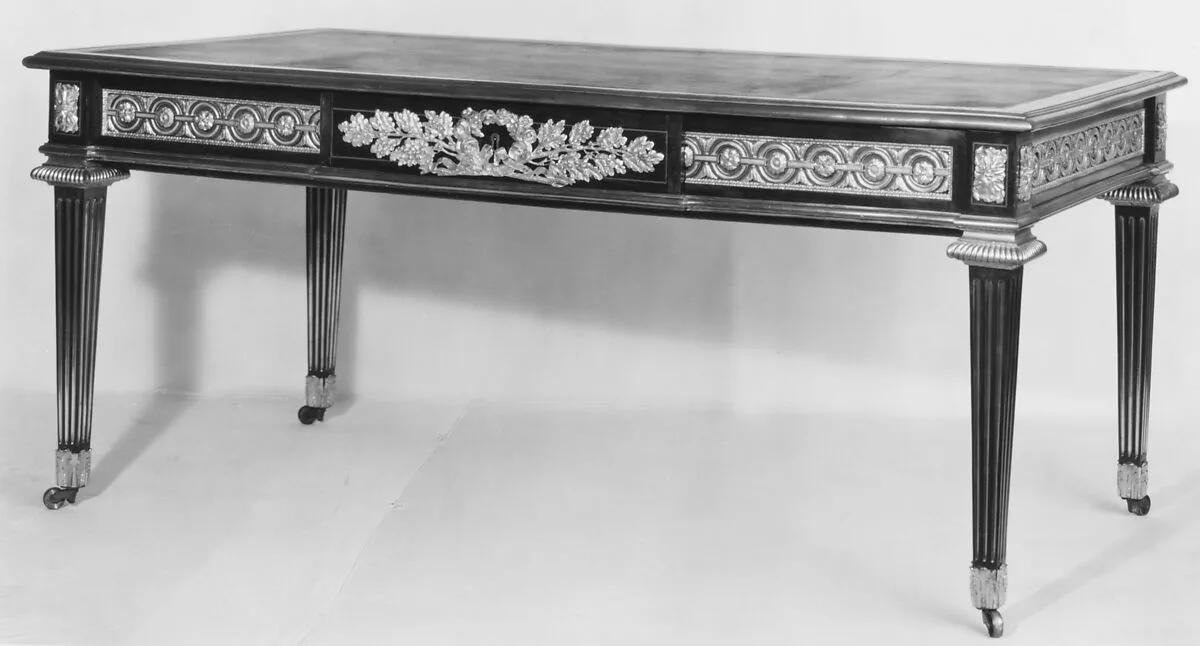
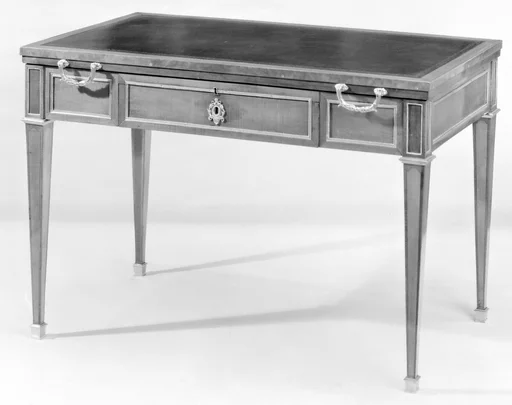
This bureau plat by Jean-François Leleu exemplifies the Neoclassical style favored by elite French patrons at the end of the eighteenth century. Jean-François Leleu (1729–1807) was trained, alongside his rival Jean-Henri Riesener, in the workshop of Jean-François Oeben. Leleu became a master ébéniste in 1764 and enjoyed the patronage of wealthy aristocrats, including the Prince de Condé, Louis-Joseph de Bourbon. Similar to the pieces produced for the prince de Condé’s Palais-Bourbon, this table reflects the strong, masculine Neoclassical forms favored by Leleu, evidenced by the tapering architectural legs and gilt-bronze ornaments. A similar writing table is rendered in the 1808 portrait of Charles Maurice Talleyrand by François Gérard also in the museum’s collection (2012.348). References: Yannick Chastang. Paintings in Wood: French Marquetry Furniture. London: The Wallace Collection, 2001. Kahtyrn Calley Galitz, "François Gérard: Portraiture, Scandal and the Art of Power in Napoleonic France," The Metropolitan Musuem of Art Bulletin, LXXI: 1 (Summer 2013), 5–48.
- Artist
- Jean-François Leleu
- Date
- ca. 1780
- Medium
- Oak, veneered with mahogany, sycamore and holly; gilt bronze, leather
- Culture
- French
- Department
- European Sculpture and Decorative Arts
- Credit line
- Gift of Mr. and Mrs. Charles Wrightsman, 1972